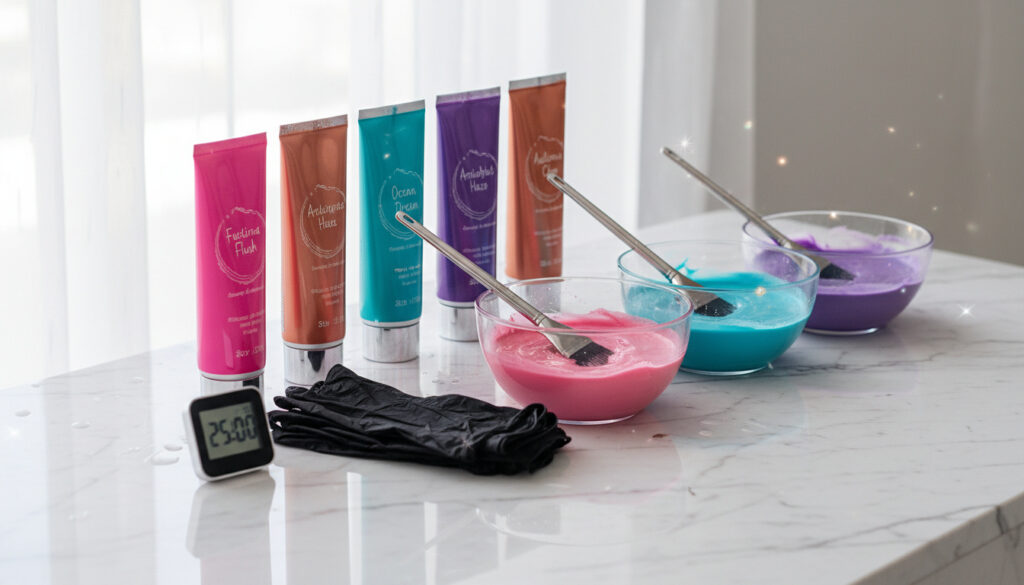
Semi Permanent Hair Colour – Duration, Safety and Application Guide
Semi-permanent hair colour offers a commitment-free way to experiment with shade, lasting between two to six weeks without the structural damage associated with permanent dyes. Unlike ammonia-based alternatives that penetrate the hair shaft, these formulas coat the surface, allowing for gradual fade-out and repeated application without compromising hair integrity.
The appeal lies in versatility. Whether seeking vibrant fashion shades on bleached hair or subtle tonal shifts on darker bases, semi-permanent options accommodate diverse goals. Understanding the mechanics of these dyes—from wash cycles to porosity factors—ensures realistic expectations and optimal results.
This guide examines the science behind ammonia-free colourants, compares available formats, and provides evidence-based timelines for longevity. From application techniques to removal strategies, every aspect draws from verified cosmetic research and industry standards.
What Is Semi-Permanent Hair Colour and How Does It Differ from Permanent?
Semi-permanent hair dye represents a distinct category within hair colour technology. These formulations contain no ammonia and require no mixing with developer, distinguishing them immediately from permanent solutions that rely on alkalizing agents to open the cuticle and deposit pigment internally.
2-6 weeks (4-15 washes)
Ammonia-free, conditioner base
Minimal to none
Experimenting, touch-ups, damaged hair
Key Characteristics:
- Fades evenly without harsh root lines or grow-out bands
- Requires no developer, eliminating mixing errors and over-processing risks
- Buildable intensity allows deeper tones through repeated applications
- Ideal for commitment-phobes seeking temporary transformation
- Enhances natural shine through conditioning carrier bases
- Safe for compromised textures, including curly and previously bleached hair
- Washes out gradually, enabling seamless transitions between fashion shades
| Feature | Semi-Permanent | Permanent | Temporary | Demi-Permanent |
|---|---|---|---|---|
| Duration | 2-6 weeks | Grows out (6-12 weeks+) | 1-2 weeks | 6-8 weeks (28 washes) |
| Lift Capability | None | 2-3 levels | None | None |
| Grey Coverage | Limited/Partial | Full | None | Partial |
| Developer Needed | No | Yes | No | Sometimes |
| Cuticle Penetration | Surface only | Full cortex penetration | Surface coating | Slight cuticle opening (Wella) |
| Damage Level | None | Higher (dries hair) | None | Minimal |
How Long Does Semi-Permanent Hair Colour Last and How to Maintain It?
Xmondo Hair technical data indicates that most semi-permanent formulations last between 2-6 weeks, translating to approximately 4-15 washes depending on the specific product and hair condition. Some premium options extend this window significantly, with certain lines providing up to 28 shampoos on porous hair when washing routines are minimised.
Variables Affecting Fade Rates
Washing frequency serves as the primary determinant of longevity. Daily cleansing shortens lifespan to 1-2 weeks, while washing 2-3 times weekly preserves colour for 4-6 weeks. Weekly washing can maintain visible tint for up to 8 weeks before complete fade-out.
Hair porosity creates divergent outcomes. Bleached or damaged hair absorbs more pigment initially due to raised cuticles, resulting in longer apparent wear but faster subsequent fading. Virgin hair shows more subtle results that diminish uniformly without stark demarcation lines.
External Accelerating Factors
Hot water, sulfate-based cleansers, and clarifying shampoos strip surface pigment rapidly. Hard water deposits minerals that bind to dye molecules, causing premature washout. UV exposure and heat styling tools open cuticle scales, allowing colour particles to escape during rinsing.
Switch to sulfate-free shampoos and rinse with cool water. Reduce washing frequency and apply colour-depositing masks weekly to refresh pigment without full reapplication.
Porous hair—whether from bleaching or heat damage—absorbs more pigment initially but releases it faster. Less porous hair shows subtler results but fades more uniformly.
Hot showers significantly accelerate fading. Lukewarm or cool water helps seal the cuticle, trapping colour molecules on the hair surface for longer-lasting vibrancy.
Extending Vibrancy Between Applications
Colour-depositing conditioners refresh tone weekly without the full processing time of initial application. Dry shampoo extends the interval between wet washes, preserving the film of colour coating the shaft.
Does Semi-Permanent Hair Colour Damage Hair and Is It Safe?
Hair by Nassi confirms that ammonia-free formulas avoid cuticle damage, making them safe for frequent use even on dry or damaged locks. The absence of harsh alkalizing agents eliminates the protein loss and breakage associated with permanent colour processing.
The Structural Advantage
Permanent colours require ammonia to swell the cuticle and deposit pigment into the cortex, fundamentally altering hair structure. Semi-permanent alternatives merely coat the exterior shaft, preserving internal integrity. This surface-action mechanism prevents the cumulative damage that restricts permanent dye frequency.
Compatibility with Compromised Hair
Curly, dry, or previously damaged hair tolerates these formulations well. The conditioning bases often improve texture during the colour process, unlike permanent alternatives that may exacerbate brittleness through oxidative stress.
Grey Coverage Limitations
White and grey hair lacks melanin and often features resistant cuticles. Semi-permanent colour provides only temporary tinting that fades faster on silver strands, making permanent or demi-permanent alternatives more suitable for comprehensive grey coverage needs.
How to Apply Semi-Permanent Hair Colour at Home
Clairol’s application guidelines specify a straightforward process requiring no professional mixing or sectioning clips beyond standard preparation. Processing takes 15-30 minutes depending on desired intensity, unlike the precise measurements required for other applications such as 32oz to ml – Exact US Conversion 946.35 ml.
Preparation Protocol
Begin with clean, dry hair sectioned into manageable quadrants. Avoid washing immediately before application to allow natural oils to protect the scalp. Remove jewelry and don protective gloves to prevent staining. If you’re looking for inspiration, you can explore various Men’s short hairstyles for men.
Application Technique
Squeeze formula directly from the ready-to-use bottle onto sections, ensuring complete saturation from roots to ends. Unlike permanent dyes, semi-permanent formulas do not require precise sectional timing or heat application, which may accelerate uneven fading.
Rinsing and Aftercare
Rinse with cool water until runoff clears completely, indicating excess pigment removal. Follow with sulfate-free conditioner to seal the cuticle. Maintenance involves weekly colour-depositing treatments to extend vibrancy without full re-colouring sessions.
The Fade Timeline: From Application to Final Rinse
- Day 0 (Application): Initial deposit creates maximum vibrancy; cuticle closes during cool water rinse, sealing colour molecules to the shaft surface.
- Wash 1-2: First signs of fading appear as loose pigment molecules release; shower water runs slightly tinted during cleansing.
- Week 2: Colour mellows into softer tones; pastel shades show significant lightening while deeper jewel tones maintain richness.
- Week 4-6: Pigment continues degrading with each wash; darker shades remain visible while fashion neons fade to pale tints.
- Week 6-8: Final traces disappear after sufficient washes with clarifying shampoo or hot water, returning hair to baseline.
Established Facts vs. Remaining Uncertainties
| Well-Established | Variable/Uncertain |
|---|---|
| Ammonia-free formulas cause no structural damage to the hair shaft | Exact wash count depends on individual hair porosity and environmental factors |
| Standard duration lasts 2-6 weeks or 4-15 washes | Vegan formula claims require individual brand verification and certification checks |
| Works best on pre-lightened hair for achieving vibrant fashion shades | Specific fade timelines vary significantly by local water hardness and mineral content |
| Gradually fades without creating visible root lines or regrowth bands | Interaction with specific prescription hair treatments remains under-studied |
The Evolution of Ammonia-Free Colouring
The hair colour industry has shifted significantly toward gentler formulations over the past decade. Modern semi-permanent dyes evolved from 1990s rinse-out conditioners into sophisticated pigment systems that deposit vibrant colour while maintaining hair health. This movement aligns with broader consumer demand for damage-free beauty solutions, particularly among those with textured or chemically treated hair who require frequent colour changes without cumulative structural compromise.
Current formulations increasingly incorporate conditioning agents that improve hair texture during the colouring process, blurring the line between cosmetic colour and hair care treatment. This hybrid approach reflects growing dermatological alignment regarding scalp safety and cuticle preservation.
Expert Verification and Source Attribution
Research from cosmetic chemists confirms that semi-permanent dyes deposit colour molecules on the hair surface rather than within the cortex. Industry technical documentation emphasizes the safety profile for frequent use, noting the absence of cuticle-altering chemicals.
Semi-permanent colour represents the safest option for clients seeking temporary transformation without compromising hair integrity, particularly for those with curly or previously damaged textures.
— Cosmetic Chemistry Standards
Brands such as Overtone provide specific wash-count benchmarks (up to 10 washes), while Clairol offers extended-wear options reaching 28 shampoos on porous hair. Salon Haze technical comparisons distinguish between temporary rinses and semi-permanent conditioners, clarifying category boundaries for consumers.
Final Considerations
Semi-permanent hair colour represents a low-risk entry point into hair colouring, offering 2-6 weeks of transformation without structural compromise. Suitable for experimentation, temporary grey blending, or conditioning colour refreshes, these ammonia-free formulas accommodate diverse hair types when applied correctly. For those interested in narrative structures and character development, explore Good Will Hunting – Plot, Cast, Ending and True Story.
Frequently Asked Questions
What are the best semi-permanent hair colours?
Top options include Clairol Natural Instincts (up to 28 washes), Overtone (up to 10 washes), and Wella’s professional range. Selection depends on desired longevity and shade vibrancy.
Can I apply semi-permanent dye to wet hair?
Application works best on dry hair. Wet hair dilutes pigment concentration and may result in uneven colour deposit or faster fading.
Will semi-permanent colour stain my skin or clothes?
Yes, temporary staining of skin and fabrics occurs. Barrier cream protects skin, while dark towels prevent clothing damage during the initial rinse phase.
Can I mix different semi-permanent shades?
Mixing compatible shades creates custom colours. Ensure both formulas are ammonia-free and from similar product lines to maintain consistent processing times.
How soon can I reapply semi-permanent colour?
Immediate reapplication is safe due to the non-damaging nature of these dyes. Many users refresh colour weekly without adverse effects.
Is semi-permanent dye safe for children?
While chemically gentler than permanent alternatives, professional consultation is recommended for minors. Patch testing remains essential regardless of age.
Can I swim in chlorinated pools with semi-permanent colour?
Chlorine accelerates fading significantly. Pre-soaking hair with fresh water and wearing a swim cap helps preserve colour during pool activities.
More related posts
 Car Rental Cairns: Deals from $17/Day at Airport
 Paul Anthony Kelly: Biography, Wife, and Career Facts
 Todd Goldstein: AFL Career, Retirement, and Family Life
 Gong Yoo: Relationship, Marriage & Kids in 2025
 Dennis Hopper: Cause of Death, Estate, and Peter Fonda Funeral Ban
 Roy Lichtenstein: Pop Art Pioneer and His Iconic Works
 Ric Flair: Diagnosis, Family Tragedy, and WWE Legacy Explained
 Ray Romano: Heart Surgery, Family & Net Worth
