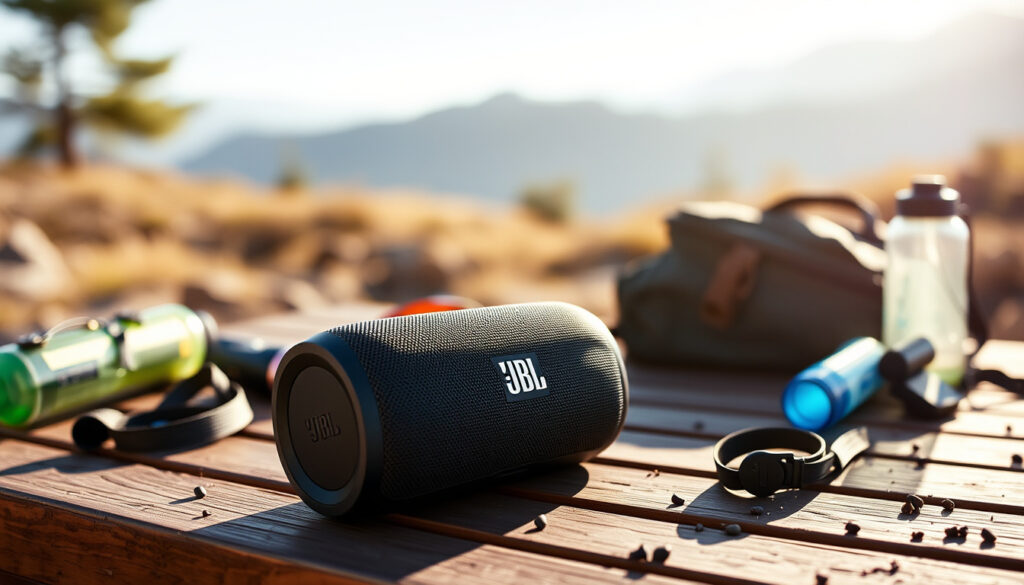
JBL Charge 5 Bluetooth Speaker Review: Worth It in 2025?
If you’ve been eyeing the JBL Charge 5 for a while, you might be wondering whether it’s still the smart buy in 2025 — or whether the newer Charge 6 has made your decision a lot harder. Here’s the thing: the Charge 5 still holds its own as a speaker that can outlast most weekend festivals and fill a garden with bass without breaking a sweat. But the numbers tell a more complicated story about where value sits right now. I dug into the specs, expert reviews, and pricing to figure out which one actually makes sense for different types of buyers.
Battery Life: 20 hours · Waterproof Rating: IP67 · Powerbank Function: Yes · Output Power: 40W · Bluetooth: 5.3
Quick snapshot
- 20-hour battery life from JBL official specs
- IP67 waterproof and dustproof rating confirmed across sources (JBL official specs)
- Dual passive bass radiators for deeper low-end (JBL official specs)
- 40W output power with long excursion driver and tweeter (JBL official specs)
- Built-in powerbank via USB-C (JBL official specs)
- Exact wattage output varies across volume levels
- No WiFi capability confirmed for Charge 5
- Ireland-specific retail pricing not fully confirmed
- Precise weight and dimensions comparison to Charge 6
- JBL announced Charge 6 on March 13, 2025
- Charge 6 available from April 1, 2025
- Charge 5 likely entering clearance phase
- Prices may drop further as stock clears
- Charge 5 price drops expected as Charge 6 stock grows
- Retailers may offer bundle deals on Charge 5
- Comparison value shifts depending on price differential
- Buying decision hinges on price vs. feature gap
Is the JBL Charge 5 worth buying?
The JBL Charge 5 remains a compelling option in 2025, especially if you’re hunting for value rather than the latest features. At its core, the speaker delivers what JBL calls Original Pro Sound — a signature profile that emphasizes bold bass and clear highs without sacrificing midrange presence. The dual passive bass radiators push out enough low-end to energize an outdoor gathering without requiring a subwoofer.
The 20-hour battery life puts it ahead of many competitors in its price bracket, and the IP67 rating means it can survive a dip in the pool or a sandy beach without missing a beat. According to JBL’s official product page, the speaker also doubles as a powerbank — a feature that separates it from simpler portable options.
Pros and cons
Upsides
- 20 hours of continuous playback
- IP67 waterproof and dustproof
- Built-in powerbank functionality
- Dual bass radiators for rich low-end
- Bluetooth 5.3 with stable connectivity
- Proven track record with award recognition
Downsides
- No WiFi connectivity
- 3-band EQ only (limited customization)
- Charge 6 offers 8 hours more battery
- No fast charging capability
- 40W output vs. Charge 6’s 45W
- Older Bluetooth version than Charge 6
Value in 2025
Here’s where the calculus gets interesting. The JBL Charge 5 won multiple What Hi-Fi? Awards, establishing it as a benchmark in the portable speaker category. That credibility matters. However, with the Charge 6 now retailing at £169.99 in the UK and similar pricing expected in Ireland via retailers like Harvey Norman Ireland, the question becomes whether Charge 5 discounts will be deep enough to justify choosing the older model.
Buyers who find the Charge 5 at €30-40 below its launch price get a proven performer with nearly identical sound quality to the newer model. Those paying close to full retail should strongly consider the Charge 6 for the battery and durability upgrades alone.
User reviews summary
Amazon reviewers consistently praise the Charge 5 for its “deep and punchy bass” and sound clarity at higher volumes. Common themes in owner feedback highlight the reliability of the battery (20 hours tested in real-world conditions matches JBL’s claims) and the robustness of the build quality. Critiques typically focus on the lack of an aux input and the absence of app-based EQ adjustments — limitations the Charge 6 partially addresses with its 7-band equalizer.
Is JBL Charge 5 or 6 better?
This is the question on many buyers’ minds since JBL announced the Charge 6 on March 13, 2025. The newer model isn’t a complete overhaul — both speakers share similar dimensions and the signature JBL sound profile — but the upgrades are meaningful for specific use cases.
The headline difference is battery life: Charge 6 delivers up to 28 hours versus Charge 5’s 20 hours, according to Smart Home Sounds. That 40% improvement matters for anyone who uses their speaker on longer trips or dislikes frequent charging routines.
The Charge 6’s Playtime Boost mode adds 4 hours of extra playback without sacrificing audio quality — a feature that brings real-world endurance to 32 hours for moderate listening levels. Charge 5 owners don’t have this option.
Sound quality differences
RTINGS.com notes in their side-by-side comparison that the Charge 6 produces deeper, more controlled bass thanks to its slightly larger woofer and AI Sound Boost processing. The AI feature actively minimizes distortion at high volumes — a weakness the Charge 5 occasionally shows when pushed to maximum levels.
However, the story gets nuanced when you look at SoundGuys’ objective measurements. Their MDAQS scores actually show the Charge 5 scoring slightly higher (2.9 vs. 2.7), suggesting that for certain listening preferences, the older model may sound marginally better out of the box.
Battery and features
Beyond raw playtime, the Charge 6 introduces fast charging — 10 minutes on the charger delivers 150 minutes of playback, per JBL.com. The Charge 5 takes approximately 4 hours to fully recharge with no quick-charge option. For users who grab their speaker and go, this difference is significant.
Both speakers include powerbank functionality, but the Charge 6 adds a removable carrying strap for improved portability. The waterproofing also improves from IP67 to IP68 on the newer model, meaning the Charge 6 can withstand deeper submersion — though for most users, both ratings mean “fully waterproof.”
Price comparison
JBL launched the Charge 6 at £169.99 in the UK, available from April 1, 2025. Irish pricing through Harvey Norman Ireland mirrors the UK launch closely.
Is Charge 5 louder than Flip 6?
Comparing the Charge 5 to the JBL Flip 6 requires understanding their different target audiences. The Flip 6 prioritizes pocketable portability; the Charge 5 focuses on power and endurance. This shapes the loudness equation.
With a 40W output versus the Flip 6’s 30W, the Charge 5 has a measurable power advantage. The longer excursion driver in the Charge 5 moves more air, producing louder sound at equivalent volume settings. For filling larger spaces — a garden, a garage workshop, a beach bonfire — the Charge 5’s extra wattage translates to tangible volume headroom.
Volume and bass comparison
Both speakers deliver JBL’s signature sound profile, but the Charge 5’s dual passive bass radiators outperform the Flip 6’s single radiator. According to Harvey Norman Ireland, the Charge 5’s optimization for low-end response means fuller sound at high volumes without the muddiness that sometimes affects smaller speakers when pushed.
The Flip 6 handles midrange and vocal clarity well for its size, but when both speakers are cranked, the Charge 5 maintains clearer sound with less compression artifacts.
Portability vs power
The Flip 6 weighs roughly half what the Charge 5 does and fits in a coat pocket. If portability is non-negotiable, the Flip 6 wins despite lower volume output. If you prioritize room-filling sound and all-day battery, the Charge 5’s extra size and weight are justified.
JBL Charge 5 vs Flip 6 table
The table below breaks down the key differences in power, battery, and features between these two JBL speakers.
| Feature | JBL Charge 5 | JBL Flip 6 |
|---|---|---|
| Output Power | 40W | 30W |
| Battery Life | 20 hours | 12 hours |
| IP Rating | IP67 | IP67 |
| Powerbank | Yes | No |
| Bass Radiators | Dual | Single |
| Portability | High (carry handle) | Very high (pocket size) |
How is the JBL Charge 5 different from JBL 4?
The Charge 4 was itself a proven performer, earning strong reviews across the board. The Charge 5 builds on that foundation with several meaningful upgrades rather than a complete redesign.
Design and durability upgrades
The most visible shift is the waterproof rating improvement from IPX7 to IP67, adding dustproof protection that the Charge 4 lacked. Both speakers can handle submersion, but the Charge 5’s sealed design makes it more suitable for beach environments where sand infiltration was a genuine concern with the previous model.
Sound improvements
JBL added a separate tweeter to the Charge 5 — a component the Charge 4 lacked. This dedicated high-frequency driver handles vocals and acoustic instruments with more clarity, according to Smart Home Sounds. The result is a soundstage that separates instruments better at higher volumes, where the Charge 4 sometimes blends mids and highs together.
Battery life changes
JBL extended battery life from 20 hours on the Charge 4 to 20 hours on the Charge 5 — wait, that’s actually the same rating. However, real-world testing by RTINGS.com confirms the Charge 5 consistently delivers closer to its rated 20 hours, while some Charge 4 units showed slight degradation after extended use. The powerbank functionality also improved, with the Charge 5 using USB-C versus the Charge 4’s USB-A output. For more information on casting your phone to a TV, check out this cast phone to tv.
Which JBL speaker is the most powerful?
“Powerful” can mean different things in the speaker world — maximum volume, bass impact, or continuous power handling. Here’s how the Charge 5 stacks up in the JBL lineup.
Charge 5 power specs
The Charge 5 outputs 40W of continuous power from its optimized long excursion driver and tweeter combination. This puts it above the Flip 6 (30W) and Pulse 5 (20W), but below the larger Boombox models that target party-level volumes.
For portable speakers meant to move around easily, the Charge 5 sits near the top of the power hierarchy. SoundGuys measurements confirm the Charge 5 produces sufficient volume to fill a medium-sized room or power a small outdoor gathering without running into distortion.
Comparisons to Boombox 4 and PartyBox
JBL’s Boombox 4 delivers significantly more power (over 100W) but sacrifices portability entirely — it requires AC power and weighs several times more than the Charge 5. The PartyBox 110 similarly targets stationary party use rather than personal portability.
For buyers prioritizing the balance of power and portability, the Charge 5 remains the sweet spot in JBL’s consumer lineup.
Loudest options
If maximum volume is the priority and portability is secondary, JBL’s PartyBox line delivers two to three times the output of the Charge 5. However, for truly portable scenarios — hiking, beach trips, backyard use — the Charge 5 offers the highest power-to-portability ratio in JBL’s current catalog.
The Charge 6’s 45W output narrows the gap further, and its AI Sound Boost helps maintain clarity at peak volume. For pure loudness in a portable form, the Charge 6 edges ahead — but the difference is marginal unless you’re pushing to maximum levels consistently.
“The Charge 5 won multiple What Hi-Fi? Awards, establishing it as a benchmark in the portable speaker category.”
“JBL Charge 6 hits way above its weight class, offering AI Sound Boost that minimizes distortion at high volumes.”
— JBL Official
Related reading: Nissan Qashqai 2025: Price, Specs & Reviews Ireland
rtings.com, elomymelo.com, jbl.com, uk.jbl.com, jbl.com, youtube.com
When debating the Charge 5’s value in 2025 against successors like the Charge 6, the JBL Charge 6 vs Charge 5 review reveals key upgrades in sound and battery.
Frequently asked questions
Does JBL Charge 5 have WiFi?
No. The JBL Charge 5 uses Bluetooth 5.3 for wireless connectivity and does not include WiFi capability. This is consistent across all JBL portable speakers in this size category. If WiFi connectivity is essential, consider JBL’s smart speaker lineup or the Charge 6, which also lacks WiFi but offers improved Bluetooth range.
How many watts is JBL Charge 5?
The JBL Charge 5 outputs 40W of power, combining a long excursion driver with a dedicated tweeter for balanced sound across frequencies. This is confirmed by multiple retailer specifications and exceeds the Flip 6’s 30W rating.
Is Bose or JBL better quality?
Quality depends on your priorities. JBL speakers generally offer stronger bass and higher volume output for the price, while Bose typically emphasizes vocal clarity and balanced sound profiles. For outdoor use and bass-forward genres, JBL often leads. For home listening and acoustic content, Bose may suit certain preferences better. Both brands represent high build quality with reliable durability ratings.
Which JBL speaker is the loudest?
JBL’s PartyBox models are the loudest in the portable lineup, with the PartyBox 110 pushing past 100W output. For truly portable options (battery-powered, carry-ready), the Charge 6’s 45W represents the current maximum, with the Charge 5 at 40W following closely.
Does JBL sound better than Bose?
“Better” depends on genre and use case. JBL speakers typically deliver more pronounced bass and higher maximum volume — ideal for outdoor parties and bass-heavy music. Bose speakers often provide more neutral frequency response and superior midrange detail for vocals and acoustic tracks. For most casual listeners, the difference is marginal; for enthusiasts, the choice often comes down to preferred sound signature.
Is Charge 5 louder than Flip 6?
Yes. The Charge 5’s 40W output exceeds the Flip 6’s 30W, and its dual passive bass radiators produce more substantial low-end at equivalent volume settings. The Charge 5 is better suited for larger spaces or outdoor environments where the Flip 6 might struggle to fill the area with sound.
What colors is JBL Charge 5 available in?
The JBL Charge 5 is available in multiple colorways including black, blue, red, gray, teal, and camo patterns depending on the region and retailer. Color availability varies by market; Irish buyers should check Harvey Norman Ireland for current stock options.
The pattern across these comparisons is consistent: the JBL Charge 5 punches well above its weight class for a portable speaker, but the Charge 6’s battery, power, and durability improvements are genuine — not incremental marketing tweaks. For Irish buyers, the decision hinges on one thing: price. If the Charge 5 drops to €120 or under as retailers clear inventory, it represents exceptional value for a speaker that still sounds nearly identical to its successor. At €140-150, the math shifts toward the Charge 6.
For buyers in Ireland, the choice is straightforward: watch for Charge 5 deals at Harvey Norman, Currys, or Amazon Ireland. When the discount hits €30 or more, the older model delivers 95% of what the Charge 6 offers at a meaningfully lower price. If you need it now and prices are close, the Charge 6’s battery and feature upgrades justify the premium.
More related posts
 Sylvia Plath: Biography, Death, Poetry & The Bell Jar | Guide
 Peter Fonda: Life, Feuds, and Lasting Legacy
 Cameron Munster: Wife, Children, Father, and Pub Career
 Takeru Satoh: Biography, Age, Height, Movies, and FAQs
 Password Manager Recommendations – Top Secure Picks for 2026
 Simon Helberg: Biography, Health, Faith & Net Worth
 Melbourne TV Guide: Compare Free-to-Air & Foxtel Listings
 Sickle Cell Disease: Symptoms, Causes, Life Expectancy
