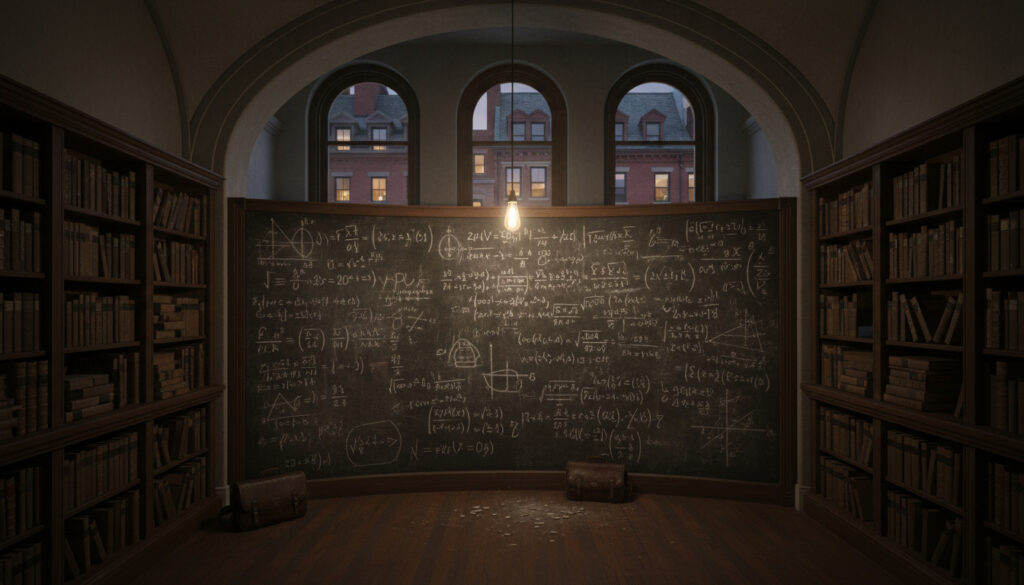
Good Will Hunting – Plot, Cast, Ending and True Story
Released in December 1997, Good Will Hunting remains a defining American drama that transformed Matt Damon and Ben Affleck from aspiring actors into Oscar-winning screenwriters. Directed by Gus Van Sant, the film stars Damon as a self-taught mathematical genius working as a janitor at MIT, whose emotional defenses are challenged by a compassionate therapist played by Robin Williams. The production, made on a modest budget, grossed over $225 million globally and earned nine Academy Award nominations, cementing its place in cinema history.
The narrative explores themes of trauma, class, and identity through the lens of Boston’s working-class neighborhoods. While the story feels authentic to its Cambridge and South Boston settings, it is entirely fictional, drawn from the writers’ own experiences and observations rather than documented events. Its success lies in balancing intellectual ambition with raw emotional honesty, creating characters that continue to resonate with audiences decades later.
Beyond its commercial achievements, the film launched one of Hollywood’s most enduring creative partnerships and provided the late Robin Williams with his only competitive Academy Award. Analysts frequently cite the movie’s therapy sequences and monologues as benchmarks for depicting mental health and male vulnerability on screen.
What Is Good Will Hunting About?
1997
Gus Van Sant
Matt Damon, Ben Affleck
126 minutes
- Breakthrough project for Matt Damon and Ben Affleck as screenwriters and leads
- Robin Williams won Best Supporting Actor at the 1998 Oscars
- Centers on a mathematical prodigy working as an MIT janitor
- Written by childhood friends drawing from authentic Boston experiences
- Nominated for nine Academy Awards, winning two
- Grossed $225.9 million worldwide against a $10 million budget
- Examines childhood trauma and the therapeutic process with unusual depth
| Fact | Details |
|---|---|
| Release Date | December 5, 1997 |
| Production Budget | $10 million |
| Global Box Office | $225.9 million |
| IMDb Rating | 8.3/10 |
| Oscar Wins | 2 (Best Original Screenplay, Best Supporting Actor) |
| Total Nominations | 9 |
| Primary Filming Location | Boston, Massachusetts |
| Production Company | Miramax Films |
Plot Overview
Will Hunting works as a janitor at the Massachusetts Institute of Technology, where he secretly solves complex mathematical problems left on hallway blackboards by Professor Gerald Lambeau. Despite his genius, Will is directionless and prone to violence, as demonstrated when he assaults a police officer during a street fight. Following his arrest, Lambeau intervenes, offering to bail Will out on the condition that he study mathematics and undergo psychological therapy.
Will initially resists treatment, mocking a series of therapists until Lambeau brings in Sean Maguire, a community college psychology professor grieving his own wife’s death. Their relationship evolves from antagonism to trust as Sean pushes Will to confront the physical abuse he suffered in foster care. Simultaneously, Will pursues a romance with Skylar, a Harvard student, though his fear of vulnerability threatens both relationships.
Ending Explained
The climax arrives through repeated therapy sessions where Sean insists that Will’s childhood abuse “wasn’t your fault,” eventually breaking through Will’s defensive calculations. Following this breakthrough, Will accepts a job offer but chooses personal connection over professional advancement. After receiving a rebuilt Chevrolet Nova from his friends for his birthday, he leaves a note for Chuckie and drives to California to pursue Skylar, having learned to embrace uncertainty and emotional risk.
Sean simultaneously reconciles with Lambeau, acknowledging their different approaches to genius and healing, before taking a sabbatical to travel the world. The ending suggests that neither mathematical ability nor trauma defines Will’s future; rather, his choice to seek connection represents the true resolution.
Who Stars in and Wrote Good Will Hunting?
Main Cast
Matt Damon anchors the film as Will Hunting, bringing both intellectual intensity and defensive aggression to the role. Robin Williams portrays Dr. Sean Maguire, the therapist who matches Will’s psychological deflections with disarming honesty. Ben Affleck appears as Chuckie Sullivan, Will’s best friend and moral compass, while Stellan Skarsgård plays the ambitious Professor Lambeau who discovers Will’s talent.
Minnie Driver stars as Skylar, Will’s love interest and a Harvard student facing her own uncertainties. Supporting roles include Casey Affleck as Morgan O’Mally and Cole Hauser as Billy McBride, members of Will’s South Boston circle. Scott William Winters appears as Clark, a Harvard student whose arrogance Will publicly dismantles in a memorable library scene.
Matt Damon and Ben Affleck wrote the screenplay during the early 1990s while sharing living quarters near Harvard Square. The script evolved through multiple drafts and initially attracted interest from director Terrence Malick before Gus Van Sant finalized the project.
Writers and Director
The screenplay originated from Damon’s original concept about a gifted young man afraid to leave his neighborhood. Damon and Affleck collaborated closely, reportedly writing scenes and trading pages to maintain consistent voice. Their shared background in Cambridge—Damon attended Harvard while Affleck grew up in the area—informed the authentic sense of place.
Gus Van Sant, known for his work on independent dramas, directed the project for Miramax Films. According to production records, filming occurred primarily on location in Boston during 1997, capturing specific neighborhoods like Southie (South Boston) and the MIT campus to ground the mathematical and class tensions in recognizable geography.
Is Good Will Hunting Based on a True Story?
Origins and Inspirations
The film is entirely fictional and not based on any specific individual or documented events. Damon and Affleck invented Will Hunting as a character, though they drew inspiration from their observations of Cambridge’s academic culture and the stark contrasts between Harvard’s privilege and South Boston’s working-class communities.
Production notes indicate that the mathematicians and therapists depicted are composites rather than portraits of real people. The writers consulted with mathematics experts to ensure the equations on MIT’s blackboards were authentic, but Will’s specific abilities and circumstances emerged from narrative imagination rather than biography.
Despite persistent rumors suggesting the film adapts a real prodigy’s story, no evidence supports this. Will Hunting is an original creation, though the writers’ intimate knowledge of Boston locations and academic environments lends the story documentary-like texture.
Did Good Will Hunting Win Oscars?
Awards Won
Good Will Hunting received nine Academy Award nominations at the 70th Academy Awards ceremony held in March 1998. The film won Best Original Screenplay for Damon and Affleck, making them among the youngest winners in that category. Robin Williams secured Best Supporting Actor for his portrayal of Sean Maguire, his first competitive Oscar after three previous nominations.
Additional nominations included Best Picture, Best Director (Van Sant), Best Actor (Damon), Best Supporting Actress (Minnie Driver), Best Film Editing, and Best Original Score. The screenplay also won the Golden Globe for Best Screenplay and earned recognition from the Writers Guild of America.
Critical Reception
Critical aggregation shows sustained acclaim for the film’s emotional authenticity and performance chemistry. Reviewers particularly highlighted the therapy scenes between Damon and Williams as masterclasses in screen acting, noting how Williams improvised portions of his dialogue while maintaining narrative integrity.
The film generated $225.9 million in global box office receipts against a production budget of approximately $10 million. This financial success surprised industry analysts who considered the subject matter—mathematical theory and psychotherapy—potentially too intellectual for mainstream audiences. For a deeper dive into his cinematic contributions, explore Jonah Hill’s films.
How Did Good Will Hunting Develop?
- : Damon and Affleck complete initial screenplay drafts while living in Los Angeles and Cambridge
- : Gus Van Sant begins principal photography in Boston locations including MIT and South Boston
- : Film premieres in limited release
- : Wide theatrical release across the United States
- : Wins two Academy Awards at the 70th Annual Ceremony
- : Releases internationally, cementing global recognition for Damon and Affleck
- : Maintains status as cultural touchstone for depictions of genius and working-class identity
Sources: Wikipedia production history and Box Office Mojo records.
True Story or Fiction: What Are the Facts?
| Established Information | Information Remaining Unclear or Disputed |
|---|---|
| Written by Matt Damon and Ben Affleck; fictional narrative | Specific real individuals who may have partially inspired character traits |
| Directed by Gus Van Sant for Miramax Films | Exact budget figure (sources cite $10–16 million range) |
| Set and filmed in Boston, Massachusetts | Current streaming availability (varies by region and licensing agreements) |
| Won 2 Academy Awards from 9 nominations | Extent of Robin Williams’ improvisational contributions versus scripted dialogue |
| Released December 5, 1997 | Specific mathematical consultants who verified the film’s equations |
What Is the Cultural Impact of Good Will Hunting?
The film established Damon and Affleck as major creative forces, launching careers that would span decades in front of and behind the camera. Its portrayal of therapy as a tool for working-class men to process trauma was relatively unprecedented in 1990s cinema and influenced subsequent dramas addressing mental health and masculinity. The “genius janitor” trope has been frequently referenced and occasionally parodied in popular culture.
Academic analyses cite the film’s examination of impostor syndrome and class anxiety within elite institutions. The therapy scenes, particularly Sean’s repetition of “It’s not your fault,” have entered cultural lexicon as shorthand for acknowledging childhood trauma and breaking cycles of abuse. Contemporary reviews note the film’s enduring rewatch value stems from its balanced treatment of intellectual and emotional intelligence.
While not based on actual events, the movie’s Boston setting revitalized interest in the city’s film industry, preceding later productions that utilized similar working-class neighborhoods. The Chevrolet Nova featured in the film’s conclusion has become an iconic visual symbol of friendship and freedom within cinema history.
Sources and Iconic Quotes
“It’s not your fault.”
— Dr. Sean Maguire (Robin Williams)
“You’ll have bad times, but it’ll always wake you up to the good stuff you weren’t paying attention to.”
— Dr. Sean Maguire (Robin Williams)
Primary sources for this analysis include Wikipedia’s comprehensive production article, TV Guide’s cast documentation, and Fandom’s script analysis. Dialogue quotations derive from the theatrical release screenplay and verified transcript sources.
Why Does Good Will Hunting Still Resonate?
Good Will Hunting endures because it balances intellectual spectacle with emotional authenticity, refusing to let mathematical genius excuse psychological avoidance. The film validates vulnerability as a strength worth cultivating, particularly through Robin Williams’ measured performance and the chemistry between old friends Damon and Affleck. Nearly three decades after its release, the story of choosing connection over isolation, and love over fear, maintains its urgency for audiences encountering similar crossroads between potential and comfort.
Frequently Asked Questions
Is Good Will Hunting based on Matt Damon’s life?
No. While Damon attended Harvard and grew up near Cambridge, the character of Will Hunting is entirely fictional. The writers drew from their Boston experiences but created the plot and characters from imagination.
Where can I watch Good Will Hunting?
Streaming availability varies by region and changes frequently. The film, a Miramax release, appears periodically on major subscription services and is available for digital rental or purchase through most online platforms. Check current listings in your territory.
What are some famous quotes from Good Will Hunting?
The most cited line is “It’s not your fault,” spoken repeatedly by Sean during therapy. Other notable quotes include Sean’s story about skipping the 1975 World Series (“I gave up my ticket… fell in love at first sight”) and his observation that the best part of any day is waking up next to someone you love.
How do Matt Damon and Ben Affleck know each other?
They grew up together in Cambridge, Massachusetts, attending the same schools and developing their acting careers simultaneously. Their friendship began in childhood, and they collaborated on the screenplay while living close to each other in their early twenties.
What kind of car does Will Hunting drive at the end?
Will receives a 1974 or 1975 Chevrolet Nova that his friends rebuilt for his birthday. The car symbolizes his community’s support and his impending departure from Boston to pursue Skylar in California.
Did Good Will Hunting win Best Picture?
No. The film was nominated for Best Picture but lost to Titanic. It won Best Original Screenplay and Best Supporting Actor for Robin Williams.
More related posts
 Na’vi Language: Origin, Phrases, Cultural Insights Guide
 Nepal vs UAE: Postponement, Qualification and Live Streaming
 Bren Foster: Real Martial Artist, Actor, and Stunt Performer
 Brittany Higgins Today: Where She Lives, Compensation, Legal Cases
 July School Holidays 2025 Ireland: Dates & Calendar
 Henry Kissinger: Controversial Diplomat and Nobel Laureate
 Missing You Netflix Series: Plot, Cast, Episodes, & Review
 Rudolf Hess: Flight, Imprisonment, and Mysterious Death
