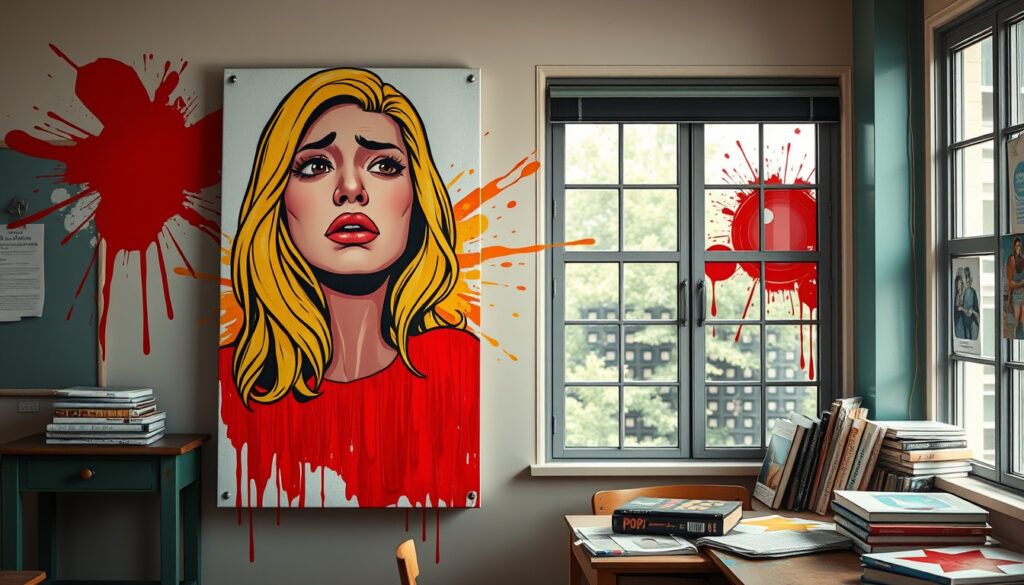
Roy Lichtenstein: Pop Art Pioneer and His Iconic Works
Few artists have reshaped how we see everyday images quite like Roy Lichtenstein. His comic strip-inspired paintings, with their bold outlines and mechanical dots, turned familiar advertisements and cartoon panels into something both playful and unsettling. This piece traces how a trained painter from New York became a defining voice of Pop Art, and why his work continues to draw crowds—and fetch nine-figure sums—decades after his death.
Born: October 27, 1923, New York City, US · Died: September 29, 1997 (age 73), New York City, US · Known for: Pop Art, comic strip–inspired paintings · Notable works: Whaam!, Drowning Girl, Look Mickey
Quick snapshot
- Born 1923 in New York City, died 1997 of pneumonia (The Matthews Gallery)
- Leading Pop Art figure of the 1960s (Ohio State University)
- Used Ben-Day dots to mimic commercial printing (National Galleries of Scotland)
- Whaam! (1963) is his most iconic painting (Tate)
- 1961: First comic-inspired painting Look Mickey (The Matthews Gallery)
- 1963: Painted Whaam! and Drowning Girl (Wikipedia)
- 2017: Masterpiece sold for $165 million (The Matthews Gallery)
Eight key facts about Lichtenstein’s life and career, one pattern: a consistent arc from academic training to deliberate, mechanical-pop aesthetics.
| Label | Value |
|---|---|
| Full name | Roy Fox Lichtenstein |
| Birthdate | October 27, 1923 |
| Death date | September 29, 1997 |
| Nationality | American |
| Education | Ohio State University (BFA, MFA) |
| Movement | Pop Art |
| Spouses | Isabel Sarisky (1949–1965), Dorothy Lichtenstein (1968–1997) |
| Children | David Lichtenstein, Mitchell Lichtenstein |
The table captures the essential biographical data of an artist who moved from academic training to mass-culture fame.
What was Roy Lichtenstein famous for?
Lichtenstein is best known for his large-scale paintings inspired by comic books and advertising. He emerged as a leading figure of the Pop Art movement in the 1960s, using bold lines, primary colors, and Ben-Day dots to create works that felt both mass-produced and meticulously handcrafted (Ohio State University).
What is Lichtenstein’s most famous piece?
- Whaam! (1963) is widely considered his most iconic painting (Tate)
- Drowning Girl (1963) is another landmark work, owned by the Museum of Modern Art (Sotheby’s)
- Look Mickey (1961) introduced his comic-strip-derived style (The Matthews Gallery)
These three works form the backbone of his early-1960s Pop period, each demonstrating his signature approach of taking a single comic panel and transforming it into a large-scale, emotionally detached composition.
How did he contribute to Pop Art?
- He is widely identified as one of the central figures of American Pop Art (The Matthews Gallery)
- Lichtenstein worked in a commercial style based on comics and advertisements (Ohio State University)
- He grew to prominence in the 1960s as one of the progenitors of Pop Art (Sotheby’s)
The implication: Lichtenstein didn’t just participate in Pop Art—he helped define its visual language, taking the aesthetics of commercial printing and elevating them to fine art status.
Why are his works so recognizable?
- His style uses bold outlines, flat colors, and hand-rendered Ben-Day dots (Wikipedia)
- Nearly all of his subject matter was taken from comic books or advertisements (Maddox Gallery)
- The resulting paintings mimic the impersonal appearance of cheap four-color printing despite being meticulously handmade (SFMOMA)
The pattern: Lichtenstein created a deliberate tension between mechanical reproduction and handcrafted art, making his works instantly identifiable while raising questions about originality and mass culture.
Lichtenstein’s paintings look like mass-produced comic strips, yet each one was painstakingly hand-painted—a contradiction that fueled both his fame and the critical debates around his work. SFMOMA notes that the enlarged Ben-Day dots became his signature mark precisely because they revealed the hand behind the mechanical illusion.
What art techniques did Roy Lichtenstein use?
Lichtenstein’s techniques were as deliberate as his subject matter. He developed a method that mimicked commercial printing while remaining entirely handmade, using a combination of traditional painting skills and innovative mechanical aids.
What is the Ben-Day dot technique?
- Lichtenstein first made use of his trademark Ben-Day dots in 1961 (National Galleries of Scotland)
- He used a perforated metal screen for the first time in 1962 to make Ben-Day dots after previously painting them by hand (National Galleries of Scotland)
- Enlarged Ben-Day dots became his signature mark (SFMOMA)
The Ben-Day dot technique, named after 19th-century printer Benjamin Day, uses small colored dots to create shading and secondary colors. Lichtenstein exaggerated the dots to a scale visible to the naked eye, turning a commercial printing trick into a fine-art signature.
How did he adapt comic book imagery?
- Lichtenstein transferred comic-book compositions to canvas with a projector and simplified them (SFMOMA)
- He often cropped and enlarged source images to emphasize composition (SFMOMA)
- His palette was typically limited to primary colors (red, yellow, blue) and black
By projecting a comic panel onto canvas and then simplifying it—removing shading, flattening depth, and adding his signature dots—Lichtenstein transformed a disposable commercial image into a monumental painting.
What materials did he use?
- He used oil and acrylic paints on canvas
- Stencils and perforated metal screens for dot patterns (National Galleries of Scotland)
- He also worked as an art teacher and created sculptures and prints
The trade-off: by using mechanical aids and a limited palette, Lichtenstein achieved a consistency that reinforced his conceptual point—that art could be both handmade and mass-produced in appearance.
What is Lichtenstein’s most famous piece?
Whaam! (1963) is widely regarded as Lichtenstein’s most famous painting. It is a diptych that depicts a fighter plane firing a rocket, based on a comic panel from DC Comics’ All-American Men of War (Tate).
Why is Whaam! so famous?
- It is housed at the Tate Modern in London (Tate)
- The Tate identifies it as one of the best known and most iconic Pop Art works (Tate)
- Its diptych format—two panels that form a single explosive image—makes it visually dramatic
The implication: Whaam! is not just famous because of its subject matter; its diptych structure forces the viewer to engage with both panels, creating a narrative tension that elevates a comic-book frame into a fine-art statement.
What is the masterpiece catalog?
- Masterpiece (1962) is one of Lichtenstein’s most recognized works
- It depicts a comic-book scene with a woman saying “I’m tired of being a masterpiece”
- It sold for $165 million in 2017, making it his most expensive painting
How does Drowning Girl compare?
- Drowning Girl (1963) is owned by the Museum of Modern Art (Sotheby’s)
- It depicts a woman submerged in water, with a thought bubble reading “I don’t care! I’d rather sink than call Brad for help!”
- Both Whaam! and Drowning Girl exemplify Lichtenstein’s signature style and theme of emotional detachment
The pattern: Lichtenstein’s most famous works all take a single emotional moment from a comic strip and freeze it, amplifying the melodrama while simultaneously draining it of genuine feeling.
What is Roy Lichtenstein’s most expensive painting?
Lichtenstein’s market value has surged in the 21st century, placing him among the top-selling artists at auction. His most expensive painting sold for a price that rivals works by Picasso and Warhol.
Which painting sold for the highest price?
- Masterpiece (1962) sold for $165 million in 2017
- Nurse (1964) sold for $95.4 million in 2015
- The Ring (1962) sold for $41.7 million in 2015
These sales have placed Lichtenstein among the top-selling artists at auction, with demand driven by his iconic status and the rarity of major works coming to market (Sotheby’s).
How much did it sell for?
- Masterpiece sold for $165 million, making it the most expensive Lichtenstein ever sold
- The buyer was reportedly hedge fund manager Steven A. Cohen
- The sale cemented Lichtenstein’s position in the top tier of 20th-century artists
Who bought it?
- Steven A. Cohen, a billionaire hedge fund manager and art collector
- Cohen also owns works by Jackson Pollock, Jasper Johns, and Andy Warhol
- The purchase was private, arranged through a dealer
Why this matters: Lichtenstein’s market performance reflects a broader shift in how Pop Art is valued—what was once dismissed as “low art” now commands prices that rival the Old Masters.
For collectors, Lichtenstein’s market is a long-term bet on the canonization of Pop Art. With major works held by institutions like the Tate and MoMA, the supply of blue-chip pieces is limited, driving prices upward at auction.
What are 5 facts about Roy Lichtenstein?
Beyond the comic strips and auction records, Lichtenstein’s personal life and career arc reveal a more complex figure—a trained artist who served in World War II, taught at universities, and never stopped experimenting.
What was his early life like?
- He was born to German Jewish immigrants in New York City on October 27, 1923 (The Matthews Gallery)
- He studied at the Art Students League with Reginald Marsh (The Matthews Gallery)
- He earned BFA and MFA degrees from Ohio State University (The Matthews Gallery)
Who was his wife?
- He married Isabel Sarisky in 1949; they divorced in 1965
- He married Dorothy Lichtenstein in 1968; the marriage lasted until his death in 1997
- Dorothy Lichtenstein is a prominent figure in the art world and oversees his estate
What was his cause of death?
- He died of pneumonia on September 29, 1997, in New York City (The Matthews Gallery)
- He was 73 years old
What other interests did he have?
- He served in the U.S. Army during World War II but did not see combat
- He worked as an art teacher at several universities
- He created sculptures, prints, and murals alongside his paintings
How did his career start?
- His first solo exhibition was in New York in 1951 (The Matthews Gallery)
- His breakthrough came in 1961 with Look Mickey, his first comic-inspired painting (The Matthews Gallery)
- By 1962, he was central to the Pop Art movement (Ohio State University)
The pattern: Lichtenstein’s career trajectory—from academic painter to commercial-inspired Pop artist—mirrors the broader cultural shift in mid-20th-century America from high art to mass culture.
Timeline
Ten key moments that trace Lichtenstein’s journey from a New York childhood to global recognition.
- 1923: Born in New York City (The Matthews Gallery)
- 1940–1943: Studied at Ohio State University; interrupted by WWII (Ohio State University)
- 1943–1945: Served in the U.S. Army
- 1949: Earned MFA; married Isabel Sarisky (The Matthews Gallery)
- 1951: First solo exhibition in New York (The Matthews Gallery)
- 1961: Created Look Mickey, his first comic-inspired painting (The Matthews Gallery)
- 1962: Painted Masterpiece; became central to Pop Art (Sotheby’s)
- 1963: Completed Whaam! and Drowning Girl (Tate)
- 1968: Married Dorothy Lichtenstein
- 1997: Died of pneumonia in New York City (The Matthews Gallery)
Confirmed facts and what’s unclear
Confirmed facts
- Lichtenstein was a leading Pop Art artist (Ohio State University)
- He used Ben-Day dots to mimic comic book printing (National Galleries of Scotland)
- Whaam! is his most famous painting (Tate)
- Masterpiece (1962) is his most expensive painting, sold for $165 million
- He died of pneumonia in 1997 (The Matthews Gallery)
What’s unclear
- The exact number of paintings he produced is not publicly tallied
- Some sources dispute whether his work was primarily critique or celebration of mass culture (SFMOMA)
What the artist and others said
“I’m not trying to improve anything; I’m just trying to paint what I see.”
— Roy Lichtenstein
“Roy was always experimenting; he never stopped pushing boundaries.”
— Dorothy Lichtenstein (widow)
“He is preeminently identified with Pop Art.”
— Roy Lichtenstein Foundation
These voices capture the essence of Lichtenstein’s approach: a painter who insisted he was simply reproducing what he saw, yet whose work sparked decades of debate about originality, mass culture, and the boundaries of art.
For new collectors and longtime admirers alike, the choice is clear: Lichtenstein’s work offers a gateway into Pop Art’s central questions about what art can be, and his legacy continues to shape how we see the images that surround us every day.
study.com, artmajeur.com, youtube.com, twinkl.com, mediagriduk.uk
For a deeper look at his most famous paintings, you can explore Roy Lichtensteins iconic works and their cultural impact.
Frequently asked questions
How did Roy Lichtenstein start his career?
He began with a traditional art education, studying at the Art Students League and earning degrees from Ohio State University. His first solo exhibition was in 1951, but his breakthrough came in 1961 with Look Mickey, the first painting to feature his comic-strip style (The Matthews Gallery).
What materials did Roy Lichtenstein use?
He used oil and acrylic paints on canvas, along with stencils and perforated metal screens to create his Ben-Day dots. He also created sculptures, prints, and murals using a variety of materials (National Galleries of Scotland).
Did Roy Lichtenstein have children?
Yes, he had two sons: David Lichtenstein and Mitchell Lichtenstein, with his second wife Dorothy.
What is the meaning behind Roy Lichtenstein’s art?
Lichtenstein’s work is often interpreted as a commentary on mass culture and consumerism, using comic strips and advertisements to question the line between high art and commercial imagery. SFMOMA notes that his paintings mimic the impersonal appearance of cheap four-color printing while being meticulously handmade.
How much does a Roy Lichtenstein print cost?
Prices vary widely depending on the edition and rarity. Limited-edition prints can range from a few thousand dollars to over $100,000, while major original paintings have sold for tens of millions at auction (Sotheby’s).
Where can I see Roy Lichtenstein’s works?
Major museums with Lichtenstein collections include the Tate Modern (London), the Museum of Modern Art (New York), the National Gallery of Art (Washington, D.C.), and SFMOMA (San Francisco). Whaam! is on permanent display at the Tate Modern (Tate).
What is the Ben-Day dot technique?
Ben-Day dots are small colored dots used in commercial printing to create shading and secondary colors. Lichtenstein enlarged them to a visible scale, using perforated metal screens to apply them consistently, making the technique a signature element of his style (National Galleries of Scotland).
Was Roy Lichtenstein influenced by other artists?
He was influenced by comic book artists, advertising designers, and earlier Pop Art figures like Jasper Johns and Robert Rauschenberg. His work also reflects the stylistic influence of the Art Students League, where he studied with Reginald Marsh (The Matthews Gallery).
Related reading: Guy Ritchie · Quincy Jones
More related posts
 Idi Amin: Biography, Facts, and Unverified Allegations
 Takeru Satoh: Biography, Age, Height, Movies, and FAQs
 Natalie Bassingthwaighte: Relationship, Career, Net Worth
 P&N Bank – Locations, Routing Number and Services in Perry, GA
 Fridges for Sale in Ireland: Cheap Deals & Retailers
 Thank You Meme Guide: Types, Origins & Where to Find GIFs
 Real Estate Perth: Median $766,500, 576 Properties for Sale
 A Court of Mist and Fury: Summary, Spice, Bans & More
