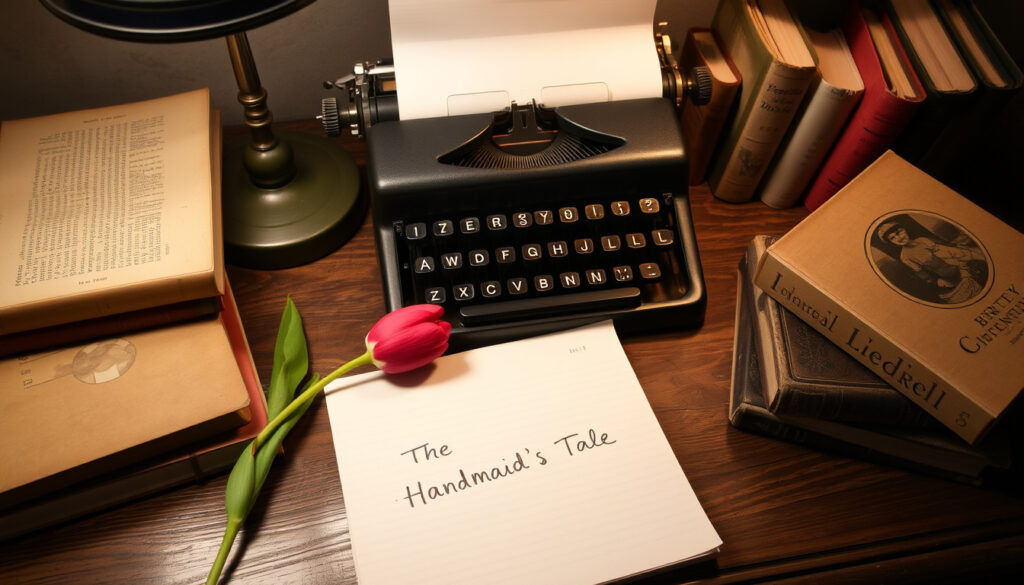
Margaret Atwood: Biography, Books, and Key Facts
Ask most people about Margaret Atwood, and the first thing they mention is The Handmaid’s Tale — that imposingly red-clad handmaid who has become a cultural shorthand for resistance. But the woman behind the dystopia was 45 when that novel appeared in 1985, and by then she’d already been writing poetry and fiction for more than two decades.
Born: November 18, 1939 ·
Nationality: Canadian ·
Notable Work: The Handmaid’s Tale (1985) ·
Awards: Booker Prize (2000, 2019) ·
Age (2025): 85 ·
Genre: Dystopian fiction, poetry
Quick snapshot
- The Handmaid’s Tale (1985) — speculative fiction about a totalitarian regime
- Adapted into an acclaimed TV series
- Booker Prize (2000 for The Blind Assassin)
- Booker Prize (2019 for The Testaments)
- Governor General’s Award, Giller Prize
- Born in Ottawa, Canada
- Married to Graeme Gibson (deceased)
- Raised in a Protestant family, identifies as agnostic
- Start with The Handmaid’s Tale
- Then Oryx and Crake for a different dystopia
- Try The Testaments for a sequel
What is Margaret Atwood Most Famous For?
Margaret Atwood’s Most Famous Works
- The Handmaid’s Tale (1985): Set in the totalitarian state of Gilead, this novel follows Offred, a handmaid forced into reproductive servitude. Britannica’s authoritative biography calls it “a dystopian novel set in New England in the near future.” It won the Governor General’s Award in 1985.
- The Testaments (2019): The long-awaited sequel to The Handmaid’s Tale, co-winner of the 2019 Booker Prize.
- Oryx and Crake (2003): The first of the MaddAddam trilogy, blending genetic engineering with ecological collapse.
- Poetry collections: Double Persephone (1961) and The Circle Game (1964) established Atwood as a poet.
The Story of Her Rejected Manuscript
Before The Handmaid’s Tale became a global phenomenon, Atwood’s first novel faced steep resistance. She has said in interviews that her early manuscript was rejected repeatedly — a figure commonly cited is 23 rejections, though Atwood herself hasn’t confirmed the exact count. Her official biography notes that The Edible Woman, her debut novel, was finally published in 1969, but the rejection experience shaped her determination.
Margaret Atwood’s Net Worth and Career Highlights
Industry estimates place Atwood’s net worth around $28 million, though this is not confirmed by the author. Her career milestones include publishing more than fifty books of fiction, poetry, critical essays, and graphic novels, and having her work published in more than forty-five countries. She has also invented a remote writing device called the LongPen, a concept she patented in 2004.
Atwood’s journey from a rejected manuscript to a multi-million-selling icon is not just a feel-good story. For aspiring authors facing their own stack of rejection letters, it is a concrete reminder: the same editors who said no to Atwood later watched her win a Booker. Persistence, not early approval, drove her career.
What is Considered Margaret Atwood’s Best Book?
Critics’ Picks: The Testaments vs. The Handmaid’s Tale
Of Atwood’s two Booker Prize winners, the official biography lists The Blind Assassin (2000) and The Testaments (2019) as the award recipients. But when readers ask about her best work, The Handmaid’s Tale is widely regarded as her masterpiece. Here’s a comparison:
| Work | Published | Award | Critical Consensus |
|---|---|---|---|
| The Handmaid’s Tale | 1985 | Governor General’s Award | Arguably her most culturally influential novel |
| The Blind Assassin | 2000 | Booker Prize | Complex narrative structure, praised as a mature achievement |
| The Testaments | 2019 | Booker Prize (co-winner) | Expands the world of Gilead, but some critics call it less powerful than the original |
| Oryx and Crake | 2003 | Shortlisted for the Booker | A modern dystopian classic, often recommended for sci-fi readers |
| Cat’s Eye | 1988 | Finalist for the Booker | Considered by some critics as her most deeply personal novel |
The implication: four books, all prize-caliber, but Atwood’s most famous work remains the one that started the cultural conversation about Gilead, not the one that collected the most awards later.
Which Margaret Atwood Book Should You Read First?
For readers new to Atwood, the starting point is straightforward. The Handmaid’s Tale introduces the core themes — power, gender, surveillance — in a tight, accessible package. After that, branching into Oryx and Crake opens up a different kind of dystopia, one rooted in biotech rather than religious extremism. The Testaments works best as a direct follow-up to the original, and for anyone interested in her poetic roots, The Circle Game won the Governor General’s Award and shows her stylistic origins.
The trade-off: starting with The Handmaid’s Tale gives you the most culturally relevant grounding, but skipping Oryx and Crake means missing her sharpest commentary on environmental collapse. For Canadian readers, Alias Grace (winner of the Giller Prize in Canada) offers a local perspective on a 19th-century murder case.
New readers: begin with The Handmaid’s Tale for maximum impact, then decide which dystopian branch — political or ecological — pulls you deeper. Canadian readers should add Alias Grace to the list for its home-court relevance.
How Old Was Margaret Atwood When She Wrote The Handmaid’s Tale?
Atwood’s Age at Publication
Margaret Atwood was 45 years old when The Handmaid’s Tale was published in 1985. She had been writing for more than 20 years by that point, having published her first poetry collection, Double Persephone, in 1961 at age 21. The novel’s late-life arrival is notable because it wasn’t a young writer’s flash of inspiration — it was the work of a mature author drawing on decades of craft and observation.
The Writing Process and Inspiration
Atwood began writing the novel in 1984, according to her biography on Britannica. The inspiration came during travels to Afghanistan and East Germany, where she saw women living under restrictive regimes firsthand. “I think of it as a work of speculative fiction,” Atwood has said about the genre, explaining that every detail in the book had a historical precedent — nothing was invented from scratch. The novel took roughly two years to write, debuting to strong reviews in 1985.
The catch: Atwood’s age at publication underscores a career built on persistence, not precocity. She was nearly half a century old when she wrote the book that defined her legacy.
What Religion is Margaret Atwood?
Atwood’s Religious Background
Atwood was raised in a Protestant family in rural Quebec and northern Ontario. Her father was a forest entomologist, and her mother was a former teacher and nutritionist. The family wasn’t strictly observant — Atwood has described her upbringing as somewhat secular, with occasional church attendance.
Her Views on Religion and Atheism
In interviews, Atwood has identified as an agnostic. She is not an atheist but rather someone who doesn’t claim certainty about the existence of a deity. The Poetry Foundation profile notes that her work “explores religious themes, especially in The Handmaid’s Tale,” where the regime’s theology is a tool of control. Atwood herself has said that writing about a theocracy doesn’t require believing in one — it requires understanding how belief can be weaponized.
The implication: Atwood’s agnosticism gives her an outsider’s eye on religious fundamentalism, which is precisely what makes her depiction of Gilead so chillingly credible.
The Handmaid’s Tale: Famous Lines and the World of Gilead
Iconic Quotes from The Handmaid’s Tale
The novel’s most quoted line is the Latin mock phrase “Nolite te bastardes carborundorum” — a made-up phrase that roughly translates to “Don’t let the bastards grind you down.” Offred (the protagonist) finds it scratched into a closet floor by her predecessor. It’s not real Latin; it’s a private code of survival.
Another famous passage: “Don’t let the bastards grind you down” — the English version of the same sentiment, which has become an activist rallying cry. Atwood also wrote the well-known opening: “We slept in what had once been the gymnasium.” The TV series adaptation has amplified these lines, turning the red handmaid uniform into a global symbol of protest.
Why Can’t Gilead Wives Have Babies?
In the world of The Handmaid’s Tale, most people in Gilead are infertile — a condition that the novel attributes to environmental pollution and sexually transmitted diseases that predate the regime. The ruling class, called Commanders, and their wives are typically unable to conceive, which is why the system forces fertile women (handmaids) into surrogacy roles. The handmaids are assigned to Commanders’ households and subjected to monthly ceremonial rape (called “The Ceremony”) under the biblical precedent of the story of Rachel and Leah.
The catch, as Atwood has pointed out: every detail of this system was drawn from historical records of real theocracies and repressive regimes. The horror isn’t imagined — it’s compiled.
Confirmed Facts vs. What Remains Unclear
Confirmed facts
- Born November 18, 1939, in Ottawa, Canada — Official biography
- Published The Handmaid’s Tale in 1985 — Britannica
- Won two Booker Prizes (2000, 2019) — Official biography
- Won two Governor General’s Literary Awards — Britannica
- Identifies as agnostic — public interviews
- Has published more than fifty books — Official biography
What’s unclear
- Exact net worth: Estimated at $28 million, not confirmed by Atwood
- Specific number of manuscript rejections: Commonly cited as 23, but not officially verified by Atwood
- Full details of her LongPen invention revenue: Patented but not publicly disclosed
Key Quotes from Atwood and Her Work
“I think of it as a work of speculative fiction.”
— Margaret Atwood, on the genre of The Handmaid’s Tale
“Nolite te bastardes carborundorum.”
— Offred, The Handmaid’s Tale (Latin mock phrase: “Don’t let the bastards grind you down”)
Two voices, one message: Atwood and her character Offred both insist on survival through defiance. The author frames her work as rational projection of history; the character speaks the desperate password of those inside the machine.
Timeline Signal
- 1939 — Born in Ottawa, Canada
- 1961 — Published first poetry collection, Double Persephone (won E.J. Pratt Medal)
- 1964 — Published The Circle Game (won Governor General’s Award)
- 1969 — Published first novel, The Edible Woman
- 1985 — The Handmaid’s Tale published (won Governor General’s Award)
- 2000 — Won Booker Prize for The Blind Assassin
- 2003 — Published Oryx and Crake
- 2019 — Won Booker Prize for The Testaments
- 2025 — Still actively writing at age 85
en.wikipedia.org, audible.com, ebsco.com, youtube.com, instagram.com
Frequently asked questions
How many Booker Prizes has Margaret Atwood won?
She has won two: in 2000 for The Blind Assassin and in 2019 for The Testaments.
What is the writing style of Margaret Atwood?
Atwood’s style is precise, ironic, and often detached. She uses a third-person limited perspective in her fiction, with sharp observational detail and thematic focus on power, gender, and environmental decay.
Is Margaret Atwood still actively writing?
Yes. At age 85 in 2025, she continues to write and publish. Her most recent major work is The Testaments (2019).
What is the significance of the title “The Handmaid’s Tale”?
The title refers to the handmaid herself as a narrator whose “tale” (story) is told, but with a pun — in the world of Gilead, a handmaid’s “tale” can also evoke her reproductive function (tail).
Has Margaret Atwood written any poetry?
Yes. She first came to public attention as a poet in the 1960s. Her debut was Double Persephone (1961), and her collection The Circle Game (1964) won the Governor General’s Award.
What environmental causes does Margaret Atwood support?
Atwood is a vocal environmental activist, particularly focused on climate change and bird conservation. She has supported organizations like BirdLife International and has written about ecological collapse in the MaddAddam trilogy.
Was Margaret Atwood ever married?
Yes, she was married to the Canadian writer Graeme Gibson from 1973 until his death in 2019. They had one daughter together.
Related reading
More related posts
 Humphrey Bogart: Smoking, Illness, and Final Days
 The Surfer Reviews – Pricing, Features and Ratings 2025
 Bin Chickens: Why They’re Called That, Facts & More
 Ray Romano: Heart Surgery, Family & Net Worth
 Donald Sutherland Illness and Cause of Death Details
 Narcissist Traits: Key Signs, Habits, and Red Flags
 Ranveer Singh: Biography, Age, Height, Net Worth, Wife & More
 Robson Green: Biography, Wife, Children, and Career Facts
