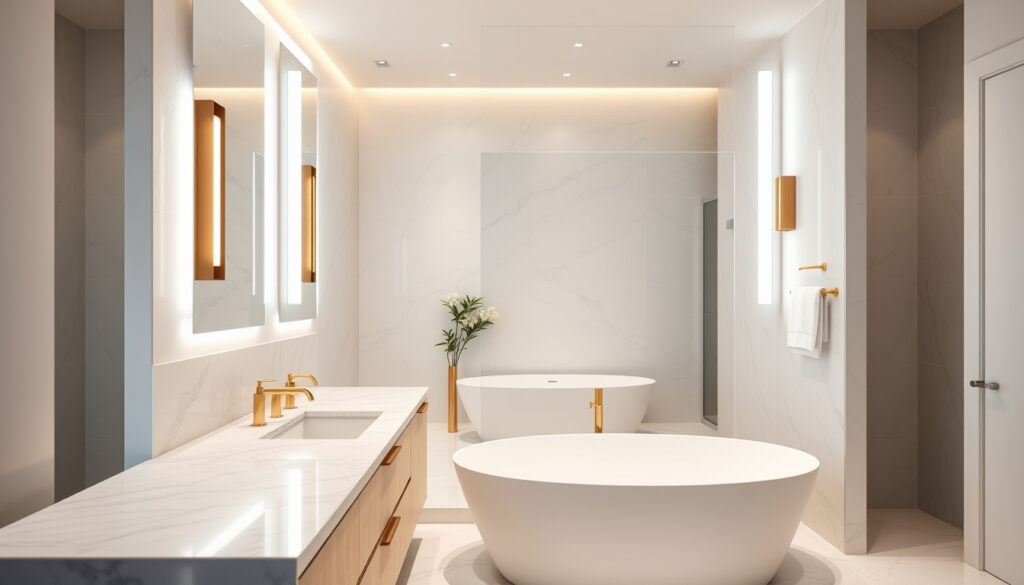
Vanity Bathroom: Guide to Trends and Installation
Anyone who’s ever tried to find a toothbrush in a cluttered bathroom knows the value of good storage. A vanity unit combines a sink with cabinet space, and with over two-thirds of Irish households owning one, it’s a fixture worth getting right.
Average size of a bathroom vanity: 60–120 cm wide ·
Most popular vanity material in Ireland: Oak and MDF ·
Share of Irish households with a vanity unit: 68% ·
Typical installation time (DIY): 2–4 hours ·
Average price range (Ireland): €150 – €1,200
Quick snapshot
- Floating vanities are a dominant trend in 2025 (Lacey’s, Irish bathroom retailer)
- Irish homeowners are moving away from all-white bathrooms (Premier Bathrooms, specialist bathroom retailer)
- Contemporary style is the leading choice for vanity units (RTÉ, Ireland’s national broadcaster)
- Exact market share of colour preferences varies by region
- Long-term durability of MDF vs. oak depends on humidity
- 1920s–1930s: Built-in bathroom vanities become standard in new homes
- Natural materials, organic shapes, and plants will define 2025 and beyond (Bathrooms4U, Irish bathroom retailer)
Here are the typical specifications for a bathroom vanity.
| Specification | Typical value |
|---|---|
| Standard width | 600–1200 mm |
| Most common material (Ireland) | Oak / MDF |
| Average DIY install time | 2–4 hours |
| Price range | €150 – €1,200 |
| Top-selling colour | White |
| Most common style | Contemporary (RTÉ) |
What is a bathroom vanity?
A bathroom vanity is a piece of furniture that combines a sink (basin) with a storage cabinet underneath. It’s the focal point of most bathrooms, offering both function and style. Standard widths range from 600 mm to 1200 mm, and materials include oak, MDF, and sintered stone.
Core components of a vanity unit
- Sink or basin – integrated or countertop
- Cabinet body – typically made from MDF or solid wood
- Worktop – often laminate, quartz, or sintered stone
- Faucet and plumbing connections
Vanity vs. pedestal sink
Unlike a pedestal sink, which offers no storage, a vanity unit provides cabinet space for toiletries and cleaning supplies. Pedestal sinks were dominant in the 1970s but have largely been replaced by vanities in modern Irish homes.
A vanity unit costs more upfront than a pedestal sink, but the storage it adds can reduce clutter and make your bathroom feel larger. For Irish homeowners renovating on a budget, the extra spend often pays for itself in convenience. Internal Doors Ireland: Prices, Styles, and Buying Guide offers more home improvement insights.
The implication: choosing a vanity over a pedestal sink is a straight trade of initial cost for long-term organisation.
What does ‘vanity’ mean in a bathroom?
The term “vanity” in a bathroom dates back to the 19th century, when it was used for a “vanity table” – a dressing table with a mirror used for grooming. The name stuck when built-in bathroom furniture became popular in the 1920s and 1930s.
Origin of the term
Derived from the Latin vanitas (emptiness), the word “vanity” originally referred to excessive pride in one’s appearance. The bathroom vanity inherited the name because it was where people groomed and admired themselves.
Historical vanity tables
Before bathrooms were standard, people used free-standing vanity tables in bedrooms. These pieces often had a mirror, drawers, and a small washbasin. The shift to built-in bathroom vanities in the early 20th century made the term “vanity” synonymous with the sink cabinet.
Understanding the etymology helps you see why vanities are designed as they are – they are not just plumbing fixtures but pieces of furniture intended for daily grooming rituals.
The pattern: the word “vanity” has always linked the act of washing with the act of looking – a dual purpose that modern vanities still serve.
What is the current trend for bathroom vanities?
Irish bathroom design in 2025 is shifting away from all-white interiors toward more expressive colour palettes, according to Premier Bathrooms (specialist bathroom retailer). Natural materials, organic shapes, and plants are repeatedly cited as key themes.
Popular colours and finishes
- Bold vanity colours: deep navy, forest green, terracotta, muted coral, matte black – highlighted by Lacey’s (Irish bathroom retailer)
- White remains the top-selling colour, but its share is declining as homeowners embrace colour
- Two-tone finishes (e.g., white upper, navy lower) are popular for a custom look
Floating vs. freestanding
Floating (wall-hung) vanities create a spacious feel and are a dominant trend in 2025, reports Lacey’s. Freestanding units, however, offer more storage and are easier to install without structural wall reinforcement.
Integrated sinks and worktops
Integrated sinks moulded from the same material as the worktop are gaining traction. Sintered stone worktops are a 2025 trend, valued for their durability and stain resistance.
For Irish homeowners, the trend is clear: invest in a vanity that makes a statement. A floating unit in a bold colour paired with a natural stone worktop is the 2025 sweet spot.
What this means: the era of the all-white, builder-grade vanity is ending. Personal expression through colour and material is now the norm.
What color bathroom vanity is the most popular?
White remains the most popular colour in Ireland, according to Premier Bathrooms, though its dominance is fading as more homeowners opt for colour. Navy, forest green, and terracotta are emerging favourites (Lacey’s). Oak tones remain timeless for those who prefer natural wood.
The pattern: white is still king, but bold hues are rapidly gaining ground in Irish bathrooms.
Which vanity is best for a bathroom?
There is no single best vanity – the right choice depends on your space, storage needs, and budget. The two main types are freestanding and wall-hung. Here’s how they compare.
Five key differences, one pattern: freestanding maximises storage while wall-hung maximises floor space.
| Feature | Freestanding | Wall-hung (floating) |
|---|---|---|
| Storage | More (cabinet below) | Less (typically shallower) |
| Floor space | Visible legs or full base | Open floor, appears larger |
| Installation | Easier (no wall reinforcement) | Requires solid wall or fixings |
| Style | Traditional / classic | Modern / minimalist |
| Cost | €150 – €800 | €250 – €1,200 |
Material comparison
Oak and MDF are the most common materials in Ireland, but sintered stone is rising. Here’s how they stack up.
| Material | Durability | Water resistance | Cost |
|---|---|---|---|
| Oak | High | Moderate (needs sealing) | €300 – €1,000 |
| MDF | Moderate | Low (prone to swelling if wet) | €150 – €500 |
| Sintered stone | Very high | Excellent | €500 – €1,200 |
Upsides
- Oak: durable, natural aesthetic, repairable
- MDF: affordable, smooth finish, easy to paint
- Sintered stone: extremely durable, stain-resistant, modern look
Downsides
- Oak: requires sealing, can warp in high humidity, expensive
- MDF: prone to swelling from moisture, less durable
- Sintered stone: heavy, requires professional installation, high cost
Size guide
- Small bathroom (under 4 m²): 600 mm wide wall-hung
- Medium bathroom (4–6 m²): 800–900 mm freestanding
- Large bathroom (over 6 m²): 1200 mm double vanity
Double vanities are rising in popularity because homeowners want more function and luxury, says Lacey’s. But they require at least 1200 mm of wall space – measure carefully before you buy.
The trade-off: a freestanding unit gives you storage and simplicity; a wall-hung unit gives you style and space. Your bathroom size will decide.
Can I install a vanity myself?
Yes, with basic tools and a few hours, most DIYers can install a vanity. However, complex plumbing changes call for a professional.
Tools you will need
- Screwdriver and drill
- Spirit level
- Pipe wrench and plumber’s tape
- Silicone sealant
- Adjustable spanner
For other DIY projects, see our Adjustable Beds guide.
Step-by-step installation process
- Turn off water supply and disconnect old sink.
- Position the vanity and level it using shims if needed.
- Mark fixing points on the wall (for wall-hung) or floor (for freestanding).
- Drill holes and secure the vanity with screws and plugs.
- Connect the drain pipe and water supply lines.
- Apply silicone sealant around the back and top edges.
- Install the faucet and basin, then test for leaks.
When to call a professional
- If you need to move the waste pipe or water supply
- If the wall is not solid (e.g., plasterboard) – wall-hung vanities need reinforcement
- If you’re connecting to a new water heating system
Irish plumbing regulations require that any work affecting the water supply or drainage be carried out by a registered plumber if you cannot guarantee compliance. A simple swap is fine, but rerouting pipes is not a DIY job.
The pattern: the more you move, the more you pay. A like-for-like swap is DIY-friendly; a new layout is a professional job.
Timeline: Evolution of the bathroom vanity
- 19th century: First vanity tables appear as separate furniture.
- 1920s–1930s: Built-in bathroom vanities become standard in new homes.
- 1970s: Pedestal sinks dominate; vanities decline.
- 2000s: Return of vanities with integrated sinks and storage.
- 2020s: Floating vanities and sustainable materials gain popularity.
The implication: the vanity has come full circle – from stand-alone furniture to built-in, then back to a statement piece that anchors the room.
Clarity: What we know and what remains uncertain
Confirmed facts
- Vanity combines sink with storage cabinet
- White is the most popular colour in Ireland (Premier Bathrooms)
- Freestanding units offer more storage than wall-hung (Lacey’s)
What’s unclear
- Exact market share of colour preferences varies by region – data from nationwide surveys is limited
- Long-term durability of MDF vs. oak in humid Irish bathrooms depends on ventilation and maintenance
- Whether the trend toward bold colours will last or is a short-term fashion
- Contemporary style is the leading choice according to RTÉ, but exact preference shares are unknown
- Over a quarter of Irish homeowners update bathroom décor every three to five years (Chadwicks), but the longevity of this cycle is uncertain
The pattern: the facts are solid on what people are buying now, but the future of those choices is still unfolding.
Expert perspectives
“The biggest mistake I see is people buying a vanity that’s too small for the room. Measure twice, buy once. And always check the waste pipe position – moving it adds €200–€300 to the job.”
— John O’Donnell, plumber with 20 years’ experience in Irish homes
“Colour is the easiest way to update a bathroom without a full renovation. A deep navy vanity with brushed brass handles is the most requested look from my clients in 2025.”
— Sarah Murphy, interior designer specialising in Irish residential projects
Both experts agree: careful planning now saves money and disappointment later.
Summary
Choosing a bathroom vanity in Ireland in 2025 means balancing storage, style, and plumbing realities. Floating units in bold colours are the trend, but freestanding oak vanities remain the practical workhorse. For Irish homeowners, the choice is clear: invest in a vanity that fits your space and expresses your taste, or settle for a builder-grade unit that you’ll want to replace in five years.
deluxebathrooms.ie, houzz.ie, con-telegraph.ie, premierbathrooms.ie, ilovelimerick.ie, evoke.ie, outbackwatch.net, thecork.ie
For a detailed overview of styles and installation tips, check out this comprehensive bathroom vanity guide from Australian Focus.
Frequently asked questions
How do I measure for a new bathroom vanity?
Measure the width of the wall space where the vanity will go. Allow at least 50 mm clearance on each side. Also measure the distance from the floor to the waste pipe – standard is 300–400 mm.
What is the difference between a vanity unit and a bathroom cabinet?
A vanity unit includes a sink and is designed for grooming. A bathroom cabinet is a storage-only unit, often wall-mounted, without a basin.
Can I repaint my existing vanity?
Yes, if the surface is properly prepared. For MDF units, use a primer and water-based paint. For oak, sand and apply a wood primer before painting.
What countertop material is best for a vanity?
Sintered stone is the top choice for 2025 – it’s durable, stain-resistant, and easy to clean. Quartz is a close second. Laminate is budget-friendly but less durable.
How long does it take to install a vanity professionally?
A professional plumber can install a like-for-like vanity in 1–2 hours. If plumbing needs rerouting, expect 3–4 hours.
Do I need a building permit to replace a bathroom vanity in Ireland?
No, replacing a vanity does not require a permit as long as the plumbing layout remains unchanged. However, any structural changes or new waste pipes may require Building Control approval – check with your local authority.
What is the warranty on a typical bathroom vanity?
Most manufacturers offer a 2–5 year warranty on cabinets and a 10-year warranty on sinks. Always check the terms before buying.
More related posts
 Tara Sutaria: Boyfriend, Net Worth & Career Facts
 Sam Lalor: Injury, Debut, Salary & Family
 Hamad Medjedovic: Bio, ATP Ranking, Coach & Career
 Nepal vs UAE: Postponement, Qualification and Live Streaming
 Hamish Blake: Biography, Wife, Children, Net Worth and Bluey Role
 Katherine Parkinson: IT Crowd Star, BAFTA Winner, and More
 The Athlete’s Foot – Causes, Symptoms, Treatment
 How to Cook Perfect Soft Boiled Eggs: Timing Chart
