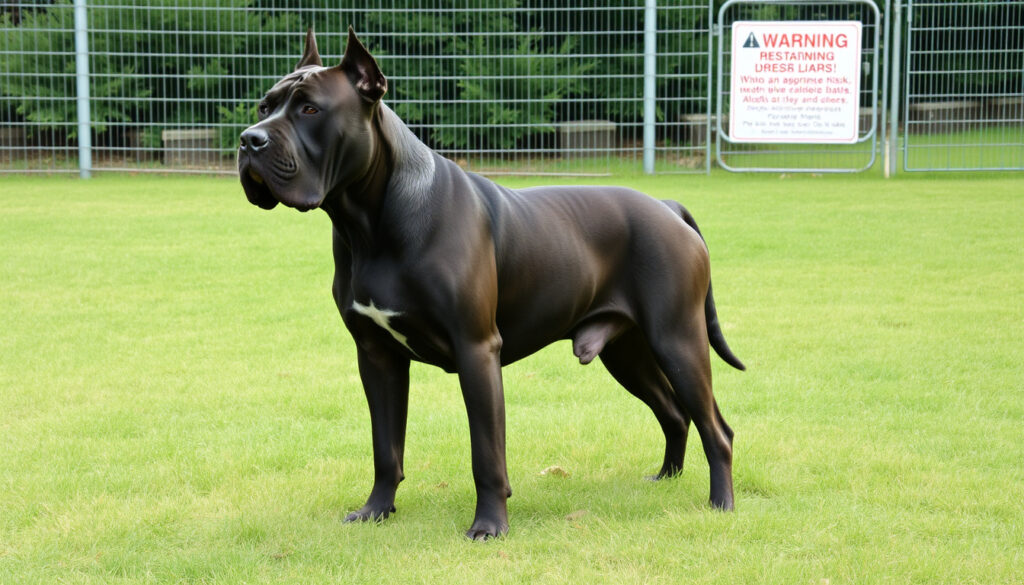
Cane Corso: Temperament, Care, and Aggression Risks
Few dog breeds stop people mid-conversation quite like the Cane Corso, with a frame built for protection and a history stretching back to ancient Rome. This Italian mastiff carries a presence that’s hard to ignore—and even harder to manage without the right groundwork.
Height: 23.5–27.5 inches (60–70 cm) ·
Weight: 90–120 pounds (40–54 kg) ·
Lifespan: 9–12 years ·
Energy Level: Moderate to high ·
Coat Type: Short, dense double coat
Quick snapshot
- Italian Mastiff breed recognized by AKC in 2010 (American Kennel Club breed standard)
- Average lifespan 9–12 years (The Spruce Pets)
- Described as a guardian of property, family and livestock (Canadian Kennel Club breed standard)
- Exact ranking on dangerous-dog lists varies by jurisdiction and organization
- Prevalence of owner-directed aggression compared with other mastiff breeds is not statistically well-documented
- Whether the breed is suitable for homes with children depends heavily on individual temperament and socialization
- Ancient Roman war dog used for hunting and guarding (Britannica)
- Near extinction in the mid-20th century; revival began in the 1970s (Britannica)
- AKC recognition in 2010 placed the breed in the Working Group (Britannica)
- Prospective owners should budget $1,500–$4,500 for a puppy and $16,900–$38,680 in lifetime care (iHeartDogs)
- Early socialization and consistent training are non-negotiable for safe family integration (iHeartDogs)
Eight key specs, one pattern: the Cane Corso is a large, ancient working breed with specific care demands that reward experienced owners but punish unprepared ones.
| Specification | Detail |
|---|---|
| Origin | Italy |
| Breed Type | Mastiff |
| Height (Male) | 25–27.5 in (64–70 cm) |
| Height (Female) | 23.5–26 in (60–66 cm) |
| Weight Range | 88–120 lb (40–54 kg) |
| Life Expectancy | 9–12 years |
| Coat Colors | Black, gray, fawn, red, brindle |
| AKC Recognition | 2010 (Working Group) |
Is a Cane Corso a good pet to have?
What is the temperament of a Cane Corso?
- The AKC breed standard calls the Cane Corso “assertive and confident, a peerless protector” who is intelligent, easily trained, docile and affectionate with family, and not a social butterfly with strangers (American Kennel Club breed standard)
- Forbes Advisor describes the breed as sweet, sensitive, loving, calm, and serious rather than bubbly or outgoing (Forbes Advisor)
- The Spruce Pets lists the Cane Corso as reserved, quiet, gentle, calm, stable, and even-tempered (The Spruce Pets)
- CareCredit notes that a well-socialized Cane Corso should be reserved and aloof toward strangers but may show aggression toward a threatening person or a dog that violates its territory (CareCredit)
The pattern is clear: the Cane Corso’s temperament is a reflection of its upbringing, not a fixed trait.
Are Cane Corso difficult dogs?
- Britannica rates the breed as fairly independent and about average in ease of training, which means a novice owner will struggle without professional guidance (Britannica)
- CareCredit reports that Cane Corsos respond best to positive reinforcement and are surprisingly sensitive and soft-hearted to correction (CareCredit)
- DogTrusts.ie advises that Cane Corsos need “plenty of space and an experienced owner” (DogTrusts.ie)
- The breed’s strong prey drive and territorial nature can make multi-pet households challenging, particularly with same-sex dogs (Britannica)
The difficulty scales with owner inexperience. A Cane Corso that receives firm, consistent, reward-based training from day one is manageable; one that doesn’t can overwhelm even a well-intentioned household.
Is Cane Corso an aggressive breed?
Are Cane Corsos dangerous?
- The breed appears on some dangerous-dog lists, though not all jurisdictions include it. The AKC standard explicitly states that timidity or fear should be considered a serious fault and never rewarded—underscoring that confidence, not aggression, is the breed goal (American Kennel Club breed standard)
- Britannica notes the Cane Corso is not particularly trusting of strangers and is not very friendly toward other dogs or animals (Britannica)
- PDSA advises that the breed “can be wary of strangers and require early socialization” (PDSA)
- Data from DogsBite.org indicates Cane Corsos have been involved in fatal attacks in the U.S., but owner responsibility—including failure to supervise, contain, or train—is consistently identified as a contributing factor (DogsBite.org)
A poorly bred or unsocialized Cane Corso can indeed be dangerous. But the same data shows that well-managed individuals from reputable breeders rarely make headlines. The risk is real, but it is conditional—not inherent to every dog.
What this means: danger in this breed is largely a management failure, not a genetic inevitability.
Can Cane Corsos turn on their owners?
- Aggression toward owners is rare when the dog is properly socialized and trained. CareCredit emphasizes that Cane Corsos are “surprisingly sensitive and soft-hearted” and bond deeply with their families (CareCredit)
- The Canadian Kennel Club standard describes the breed as “extremely agile and responsive,” suggesting a dog that takes direction well when handled correctly (Canadian Kennel Club breed standard)
- Cases of owner-directed aggression typically involve dogs from backyard breeders or rescue situations with unknown history—not dogs raised in stable, trained environments.
Owner-directed aggression is not a breed trait; it’s a failure of environment, breeding, or handling. The Cane Corso is a guardian, and a guardian that trusts its owner does not attack them.
What are the disadvantages of a Cane Corso?
How much does a Cane Corso cost?
- The average breeder price for a Cane Corso puppy on Good Dog is $3,050 (Good Dog)
- Regional U.S. prices range from $1,000 to $3,000 in the Midwest, $1,200 to $3,500 in the South, $1,500 to $4,000 in the Northeast, and $1,500 to $4,500 in the West (iHeartDogs)
- Lifetime care costs—excluding the purchase fee—are estimated between $16,900 and $38,680 (iHeartDogs)
- Many landlords and insurance companies restrict the breed, adding potential housing costs or requiring premium policy riders.
What health issues do Cane Corsos have?
- Common health problems include hip dysplasia, bloat (gastric dilatation-volvulus), and eyelid abnormalities such as entropion and ectropion (PDSA)
- The breed’s deep chest makes it especially prone to bloat, a life-threatening emergency that requires immediate veterinary intervention.
- A responsible breeder will screen for hip and elbow dysplasia and provide cardiac and ophthalmologic clearances—adding to the upfront cost but reducing long-term risk.
The upfront price tag is just the entry fee. Between potential health emergencies, breed-restricted housing, and the need for professional training, a Cane Corso owner should expect to spend $2,000–$4,000 annually beyond routine care. Budgeting for bloat surgery alone (often $1,500–$7,500) is prudent.
The financial and logistical demands of this breed are substantial, and owners must prepare accordingly.
Is a Cane Corso a mastiff or pitbull?
How big do Cane Corsos get?
- Males stand 25–27.5 inches (64–70 cm) at the shoulder; females measure 23.5–26 inches (60–66 cm) (The Spruce Pets)
- Weight ranges from 88 to 120 pounds (40–54 kg), placing the breed solidly in the giant category.
- This size, combined with a muscular, solid build, makes the Cane Corso one of the most physically imposing companion breeds.
How much does a Cane Corso weigh?
- Adult weight typically falls between 90 and 120 pounds, with males at the upper end and females slightly lighter (Britannica)
- Puppies grow rapidly: a 12-week-old pup may already weigh 30–40 pounds, and owners must plan for a dog that will reach full size by 18–24 months.
How do you pronounce Cane Corso?
- The correct pronunciation is “KAH-neh KOR-so” — “Cane” rhymes with “bonne” (not “cane” as in sugar cane), and “Corso” has a rolled ‘r’ with a short ‘o’.
- Common mispronunciations include “KAYN KOR-so” or “KAHN KOR-so.”
The Cane Corso is unequivocally a mastiff—specifically an Italian Mastiff—not a pitbull. The confusion likely stems from its short coat and muscular build, but the two breeds share no direct lineage. The Cane Corso descends from ancient Roman war dogs used for hunting and guarding (Britannica), while the American Pit Bull Terrier was developed from bull-and-terrier crosses.
What dog beats a Cane Corso?
YouTube forums and breed-comparison threads frequently cite the Tibetan Mastiff, Kangal, and Caucasian Shepherd as possible challengers in a hypothetical confrontation. No scientific study ranks dog fighting ability across breeds, and comparisons remain entirely anecdotal (Britannica). More importantly, framing any breed around “who beats who” distracts from the real conversation: responsible ownership. A well-trained Cane Corso is not a weapon, and a well-managed home does not stage fights.
Why this matters: the question itself reflects a misunderstanding of what guardian breeds are for. The Cane Corso’s value is not in hypothetical victory over another dog—it is in its loyalty, trainability, and centuries-old role as a protector of people and property.
Pros and cons at a glance
Upsides
- Deeply loyal and affectionate with family
- Excellent guardian and watchdog instincts
- Intelligent and responds well to positive reinforcement (Forbes Advisor)
- Calm, stable, and even-tempered when properly socialized (The Spruce Pets)
- Low grooming needs—short, dense coat requires minimal maintenance
Downsides
- High purchase cost ($1,500–$4,500) and lifetime expenses ($16,900–$38,680)
- Prone to serious health issues including bloat and hip dysplasia (PDSA)
- Strong prey drive and territorial behavior, challenging in multi-pet homes (Britannica)
- Breed restrictions from landlords and insurers limit housing options
- Not recommended for first-time owners or homes with young children without experienced supervision
The decision to own a Cane Corso hinges on whether the owner can meet these substantial commitments.
What’s confirmed and what’s still unclear
Confirmed facts
- The Cane Corso is an Italian Mastiff breed (American Kennel Club breed standard)
- Average lifespan is 9–12 years (PDSA)
- The breed is classified as a working dog with strong protective instincts (Royal Canin)
- Proper socialization and consistent training are essential for safe integration into a family (CareCredit)
What’s unclear
- Exact ranking on aggressive breed lists varies by jurisdiction and organization
- Prevalence of owner-directed aggression compared to other mastiff breeds is not statistically well-documented
- Whether the breed is suitable for homes with children depends heavily on individual temperament and socialization history
- Exact historical lineage before the 20th-century revival is not fully documented
What experts say about the Cane Corso
“Assertive and confident, a peerless protector.”
— American Kennel Club breed standard (AKC)
Cane Corsos need “plenty of space and an experienced owner.”
— DogTrusts.ie (DogTrusts.ie)
The breed “can be wary of strangers and require early socialization.”
— PDSA (PDSA)
Cane Corsos are “sweet, sensitive, loving, calm, and serious rather than bubbly or outgoing.”
— Forbes Advisor (Forbes Advisor)
The Cane Corso is not a breed for everyone—and that’s exactly the point. It demands an owner who understands that a guardian dog’s loyalty is earned, not bought. For the experienced handler ready to invest in socialization, training, and veterinary care, the reward is a devoted, stable companion. For anyone looking for a low-effort pet or a status symbol, the mismatch can be costly in both money and safety. The choice is clear: prepare thoroughly, or choose a breed that matches a lower-stakes lifestyle.
breedstandardlibrary.com, sanroccocanecorso.com, youtube.com, chewy.com
Frequently asked questions
How long do Cane Corsos live?
The average lifespan is 9 to 12 years, with some well-cared-for individuals reaching 13 years (The Spruce Pets).
Do Cane Corsos shed a lot?
They shed moderately year-round and more heavily during seasonal coat changes. Weekly brushing keeps loose hair under control.
Are Cane Corsos good with children?
Britannica notes the breed is not ideal for children or seniors, though individual dogs raised with children from puppyhood can be gentle and protective. Supervision is always required.
Do Cane Corsos drool?
Yes—the breed has loose, flewy lips and drools, especially after drinking or eating. Owners should keep a towel handy.
How much exercise does a Cane Corso need?
They require at least 60 minutes of daily exercise, including walks, play, and mental stimulation. Without it, they can become destructive or restless.
Are Cane Corsos easy to train?
They are intelligent and learn quickly with positive reinforcement (Forbes Advisor), but their independent nature means a novice owner will need professional support. Consistency is key.
What is the history of the Cane Corso?
The breed descends from ancient Roman war dogs (canis pugnaces) and was used for hunting big game, herding cattle, and guarding property. It nearly went extinct in the mid-20th century before Italian breeders revived it in the 1970s (Britannica).
Do Cane Corsos get along with other dogs?
They can be dog-selective and are not well-suited for multiple-dog households, especially with same-sex dogs (Britannica). Early socialization can help, but same-sex aggression is a known risk.
More related posts
 Brian Thompson Death: UnitedHealthcare CEO Killing & Fallout
 TFT Patch Notes: Latest Updates and Schedule (2026)
 How Old Is Taylor Swift Daughter – No Children, Family Facts
 Randy Rhoads’ Plane Crash: Cause, Last Words, and Legacy
 Hailey Baptiste: Father, Ethnicity, Height, Career Earnings
 Is Lee Dong-Wook Married? Age, Height & Personal Life
 Rhea Ripley Bio: Family, Injury & Common Questions
 Bob Dylan: Biography, Net Worth, Health & Love Life
