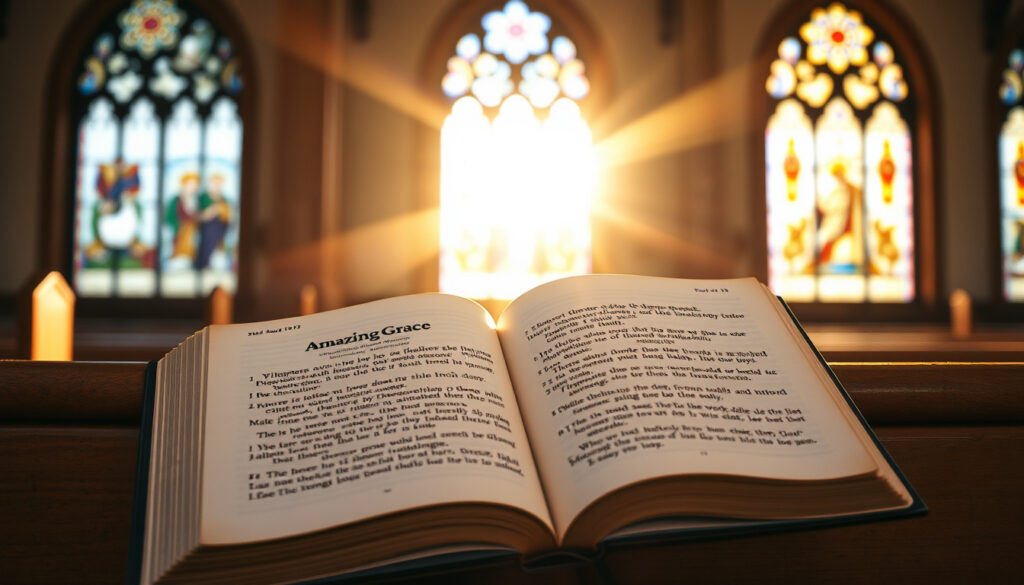
Amazing Grace Lyrics: Full Text, History & Meaning
Few hymns cut across denominational lines the way “Amazing Grace” does. Whether you’ve heard it at a funeral, a Sunday service, or a civil rights documentary, that opening line—Amazing grace! how sweet the sound—tends to land.
Written by: John Newton ·
First published: 1779 ·
Common verses: 6 ·
Top verse snippet: Amazing grace! how sweet the sound, That saved a wretch like me!
Quick snapshot
- John Newton (1725–1807) wrote the lyrics in 1772 (Wikipedia article)
- First published in Olney Hymns, 1779 (GCCSATX hymn collection)
- Former slave trader converted after a storm at sea (OCP liturgical publisher)
- Newton wrote 6 verses in 1772 (OCP liturgical publisher)
- A 7th verse was added around 1790 by an unknown hand (OCP liturgical publisher)
- The tune New Britain was paired with the lyrics in 1835 (Study.com lesson)
- Newton was ordained in the Church of England in 1764 (Straight Dope forum)
- Some Catholic hymnals soften “wretch like me” to “saved and strengthened me” (Straight Dope forum)
- Protestant versions typically retain the original wording (Straight Dope forum)
- One of the most frequently sung hymns at North American funerals (Hymnary.org database)
- Verses 3 and 4 are sometimes omitted for brevity (Songs for Funerals)
- Used for both religious and secular purposes, especially in the US (Hymnary.org database)
This reference table summarizes the essential attributes of the hymn at a glance.
| Label | Value |
|---|---|
| Author | John Newton |
| Publication year | 1779 |
| Religion | Anglican |
| Key theme | Grace and redemption |
| Verse 1 | Amazing grace! how sweet the sound |
What is the true story behind the song Amazing Grace?
The man behind these lyrics lived a life that sounds almost scripted. John Newton was born in 1725 in London, and for much of his early adulthood he worked aboard slave ships—a trade he described in brutal detail in his diaries. His conversion story centers on a violent storm in 1748 that nearly sank his vessel. Newton, who had previously given up on any religious belief, called out to God in desperation. That moment marked the beginning of his spiritual turnaround.
John Newton’s background
Newton spent years trafficking enslaved people before a series of health crises forced him off the ships. During his recovery, he began reading devotional literature and eventually sought ordination. He was ordained in the Church of England in 1764 and became the curate of Olney in Buckinghamshire, where he served for the next two decades. It was there, as an Anglican clergyman, that he began writing hymns—often composing them to illustrate his Sunday sermons.
Conversion experience
Newton tied the hymn directly to a New Year’s Day sermon on January 1, 1773 (though some records suggest he composed the verses as early as 1772). The lyrics drew heavily from his own transformation, framing his past as a “wretch” saved by unearned divine favor. He based the hymn on 1 Chronicles 17, where the word “forever” appears eight times—a detail Newton highlighted in his sermon notes. The hymn expressed his personal conversion from sin as an act of God’s grace, a concept he wrestled with throughout his adult life before embracing it fully.
The implication is that the most personal testimony can become the most universal comfort.
Amazing Grace Lyrics
When people refer to the “original” Amazing Grace lyrics, they usually mean John Newton’s six verses as published in Olney Hymns in 1779. These verses move from personal confession to eschatological hope, tracing a believer’s journey from lostness to final salvation. Below is the full original text as it appeared in the first publication.
Full original lyrics
Amazing grace! How sweet the sound
That saved a wretch like me!
I once was lost, but now am found;
Was blind, but now I see.‘Twas grace that taught my heart to fear,
And grace my fears relieved;
How precious did that grace appear
The hour I first believed!Through many dangers, toils and snares,
I have already come;
‘Tis grace hath brought me safe thus far,
And grace will lead me home.The Lord has promised good to me,
His Word my hope secures;
He will my shield and portion be,
As long as life endures.Yea, when this flesh and heart shall fail,
And mortal life shall cease,
I shall possess, within the veil,
A life of joy and peace.The earth shall soon dissolve like snow,
The sun forbear to shine;
But God, who called me here below,
Will be forever mine.
Common 6 verses
These six verses remain the standard in most Protestant hymnals worldwide. A seventh verse—When we’ve been there ten thousand years, / Bright shining as the sun…—circulated anonymously beginning around 1790, possibly appearing first in Harriet Beecher Stowe’s Uncle Tom’s Cabin (1852). Many modern church programs omit that addition entirely, sticking to Newton’s own text. The hymn has appeared in over 1,677 different hymnals since its debut, making it one of the most published songs in Western history.
Newton’s six verses carry a complete arc—from spiritual bankruptcy to eternal security—in fewer than 200 words. That economy partly explains why the hymn has outlasted countless trend-driven worship songs.
The catch is that this brevity masks a complex theological structure most singers never notice.
Is Amazing Grace a Catholic or Protestant song?
The short answer: the hymn originated firmly in Protestant tradition, specifically Anglican. But Catholic congregations have adopted it widely, sometimes with minor lyrical adjustments that reflect theological emphases on hope rather than self-deprecation.
John Newton’s religion
Newton’s ordination in the Church of England in 1764 anchors the hymn firmly in Anglicanism. He served as curate of Olney for 24 years and co-wrote the Olney Hymns collection with poet William Cowper. His theological lens was evangelical Protestant, emphasizing personal conversion, divine grace as unmerited favor, and the believer’s assurance of salvation—all themes woven through the six verses.
Denominational views
Protestant hymnals consistently retain Newton’s original wording, including the phrase “saved a wretch like me.” Catholic publications, however, have sometimes modified this line. According to community discussions and hymnal comparisons, some Catholic books change it to “saved and strengthened me” or “that saved and set me free” to soften the self-loathing tone. Wikipedia notes that recent religious publications have altered the line to downplay self-abasement, reflecting broader shifts in how congregations approach confession and divine favor. The theological difference centers on emphasis: Protestant theology often highlights human depravity and grace as rescue, while Catholic devotions tend to frame grace as healing and strengthening.
Why don’t Catholics like Amazing Grace?
Some Catholic congregations have found the hymn problematic due to its Protestant framing of human nature as fundamentally depraved and in need of rescue. The line “saved a wretch like me” conflicts with Catholic theological emphases on grace as healing and strengthening rather than rescuing from a wretched state. This difference in anthropological perspective—not any official doctrine—causes some Catholic hymnals to modify wording while others embrace the hymn unchanged.
The lyric variation isn’t trivial. “Saved a wretch like me” implies a dramatic before-and-after transformation; “saved and strengthened me” suggests gradual growth. Both are valid Christian readings, but they frame the gospel differently.
The implication is that lyrics carry theological weight even when congregations sing them unthinkingly.
Is it appropriate to sing Amazing Grace at a funeral?
For most families in North America, the answer is a clear yes. Hymnary.org lists “Amazing Grace” among the best-loved hymns sung at funerals, and Songs for Funerals confirms it as a standard selection in both religious and secular services. That said, some Catholic and Protestant clergy have specific preferences based on theological comfort or family background.
Funeral significance
The hymn’s themes of redemption, divine protection through trials, and the hope of eternal life map neatly onto funeral settings. Verse 5 (When this flesh and heart shall fail… I shall possess, within the veil, A life of joy and peace) speaks directly to loss, offering a theological vision of what lies beyond death. Verse 3’s acknowledgment of “many dangers, toils and snares” resonates with families processing grief as a journey rather than a single moment.
Popular funeral songs
Funeral directors and worship leaders often cite “Amazing Grace” alongside “It Is Well With My Soul,” “In the Garden,” and “Be Thou My Vision” as staples of memorial services. The hymn crosses cultural lines: it’s equally at home in a Baptist megachurch, a Catholic parish, or a secular memorial service in the United States. For families seeking a hymn that feels both familiar and spiritually substantive, “Amazing Grace” often tops the shortlist.
That said, some clergy note that verses 3 and 4 are occasionally omitted in funeral contexts for time or tonal reasons, since verse 3 addresses earthly trials and verse 4 focuses on present-day hope rather than afterlife assurance.
What is the hymn for comfort in death?
“Amazing Grace” serves as one of the most chosen hymns for funeral comfort, particularly verse 5 which addresses mortality directly. The verse “When this flesh and heart shall fail / And mortal life shall cease / I shall possess, within the veil / A life of joy and peace” offers a theological promise of eternal life that grieving families find consoling. This eschatological hope distinguishes it from hymns focused purely on present-day guidance.
Amazing Grace lyrics and meaning
Beyond the surface-level comfort, the hymn carries layers that reflect Newton’s specific theological reading and personal history. Understanding those layers deepens appreciation for why the song continues to move listeners.
Verse breakdowns
Verse 1 establishes the central miracle: transformation from spiritual lostness to clarity. Newton’s word choice—wretch, lost, blind—deliberately contrasts with the sweetness of grace, making the rescue feel dramatic rather than routine.
Verse 2 shifts to the moment of belief, using the word fear in a nuanced way: the fear of divine judgment that drives a person toward faith, then the relief when that fear is answered.
The first two verses trace a complete conversion arc: from being lost and blind to being found and seeing. This narrative structure is intentional.
Verses 4 through 6 telescope toward eschatology. Verse 4 makes a covenant promise: God’s word as security, God’s presence as provision. Verse 5 crosses the threshold of physical death, entering the heavenly sanctuary (“within the veil”). Verse 6 dissolves the material world entirely—earth, sun—before declaring the eternal relationship that survives it.
The pattern shows how Newton moved from personal testimony to cosmic conclusion.
Cultural impact
The hymn’s cultural reach extends far beyond church walls. It gained prominence during the US Civil Rights Movement, and Harriet Beecher Stowe featured it in Uncle Tom’s Cabin in 1852, cementing its association with enslaved people’s spiritual struggles. Modern versions like Chris Tomlin’s “Amazing Grace (My Chains Are Gone)” add choruses and contemporary instrumentation, while artists like Hayley Westenra and Phil Wickham have recorded it for crossover audiences.
The tune universally associated with the lyrics—New Britain—was paired with the text in 1835 by William Walker, a shape-note compiler. That pairing transformed a moderately successful British hymn into an American evangelical standard.
Timeline signal
The chronology below shows how a personal conversion became a cultural phenomenon.
| Year | Event |
|---|---|
| 1725 | John Newton born in London |
| 1748 | Conversion experience during storm at sea |
| 1764 | Ordained in Church of England |
| 1772 | Lyrics composed |
| 1773-01-01 | First performed for New Year’s Day sermon |
| 1779 | Published in Olney Hymns collection |
| 1790 | Anonymous seventh verse added |
| 1835 | Tune New Britain paired with lyrics by William Walker |
| 1852 | Featured in Uncle Tom’s Cabin by Harriet Beecher Stowe |
| 1807 | John Newton died in Olney |
Confirmed facts vs. What’s unclear
Confirmed facts
- John Newton wrote the lyrics in 1772 as an Anglican curate in Olney
- First published in Olney Hymns, 1779
- Newton was ordained in Church of England in 1764
- The tune New Britain was paired with lyrics in 1835 by William Walker
- The hymn is one of the most sung at North American funerals
- Newton was a former slave trader who converted after a storm at sea
What’s unclear
- The exact month and day of composition in 1772 (sources cite only the year)
- Precise publication dates for specific Catholic hymnal adaptations
- How widely the 7th verse was circulated before Uncle Tom’s Cabin
- Global ranking data comparing hymn usage across countries
- The precise degree of Newton’s involvement in the slave trade before his conversion
- How different denominations interpret the anthropological language (“wretch”) in practice
What people have said
Amazing grace! How sweet the sound That saved a wretch like me!
John Newton, Author and Clergyman
The words for the beloved song were borne from the heart, mind and experiences of the Englishman John Newton.
OCP Blog (Publisher specializing in liturgical music)
One of the best loved and most often sung hymns in North America.
Hymnary.org (Authoritative hymnal database)
What makes “Amazing Grace” endure isn’t its theological uniqueness—plenty of hymns celebrate redemption—but its stubborn specificity. Newton refused to soften his own history: “wretch” stays “wretch,” “lost” stays “lost.” That raw honesty, paired with the promise of ultimate rescue, gives the hymn its emotional reach. For families choosing music for a memorial, that same tension—grief paired with hope—often feels exactly right.
Related reading: 3 Doors Down lyrics
covlife.org, pastoralponderings.wordpress.com, hymnsocietygbi.org.uk, princetonumc.org, gloucestershire.gov.uk
Frequently asked questions
What is the hymn for comfort in death?
“Amazing Grace” is widely regarded as one of the most comforting hymns for funeral settings, particularly verse 5, which addresses the transition from mortal life to eternal peace “within the veil.”
What are Amazing Grace lyrics in English?
The original English lyrics by John Newton consist of six verses as published in 1779: “Amazing grace! How sweet the sound / That saved a wretch like me!” through “But God, who called me here below / Will be forever mine.”
Why do some Catholics see Amazing Grace as problematic?
Some Catholic hymnals modify the phrase “saved a wretch like me” to softer language like “saved and strengthened me” to align with Catholic theological emphases on grace as healing rather than rescue from depravity. This is a matter of theological preference, not official doctrine.
What are Amazing Grace lyrics 6 verses?
The six verses written by John Newton in 1772 cover themes from personal conversion (“I once was lost, but now am found”) to eternal salvation (“Will be forever mine”). A seventh verse beginning “When we’ve been there ten thousand years” was added anonymously around 1790.
Who sings Amazing Grace lyrics Phil Wickham?
Phil Wickham is among the contemporary Christian music artists who have recorded “Amazing Grace,” typically using the traditional six verses with his own musical arrangements. Other artists like Chris Tomlin have added original choruses, while Hayley Westenra performed it as a crossover piece.
What are popular funeral songs like Amazing Grace?
Other hymns frequently chosen alongside “Amazing Grace” for funerals include “It Is Well With My Soul,” “In the Garden,” “Be Thou My Vision,” and “How Great Thou Art.” The choice often depends on denominational tradition, family preferences, and whether the service is held in a church or secular venue.
More related posts
 How to Write a Cover Letter: Step-by-Step Guide & Examples
 Post Office Open Saturday: Hours, Delivery & Services (2025 Guide)
 IND vs ENG 2025: Schedule, Records & Siraj Fine
 Is Lee Dong-Wook Married? Age, Height & Personal Life
 Pillow Talk Near Me: Locations, Hours, Prices Guide
 Aldi Phone Plans: Prepaid SIM Options & Prices Australia
 iPad 11th Generation: Specs, Price, and Review (2025)
 Regretting You Book: Summary, Spoilers & Review
