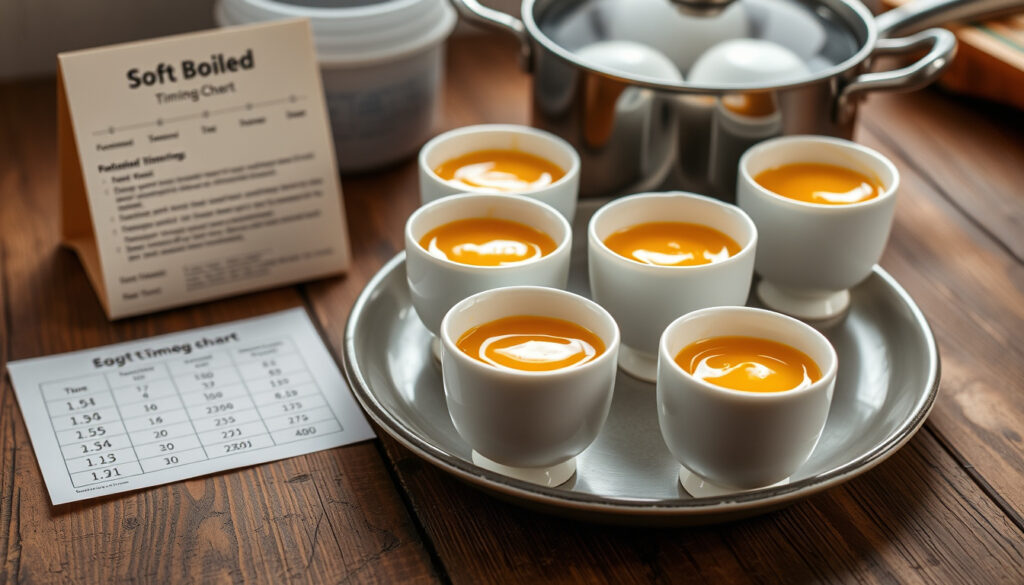
How to Cook Perfect Soft Boiled Eggs: Timing Chart
Most of us have ended up with a rubbery, overcooked yolk at least once — and wondered why something that sounds so simple trips us up. The culprit is usually a missing timer or a timing chart that doesn’t account for where your eggs started. Whether you’re pulling eggs straight from the refrigerator or they’ve been sitting on the counter, the starting temperature changes everything. Here’s a precise guide that sorts through the conflicting advice and puts a kitchen timer to the test.
Standard soft boil: 6 minutes · Runny yolk window: 5-6 minutes · Jammy yolk range: 6.5-8 minutes
Quick snapshot
- 6 minutes for runny yolk from fridge-cold eggs (RecipeTin Eats)
- Simmer over rolling boil preserves white texture (Love and Lemons)
- Ice bath minimum 3 minutes stops carryover cooking (Love and Lemons)
- Exact timing delta between fridge and room-temp eggs varies by 30-60 seconds
- Induction cooktops may need 30-60 seconds extra — source testing varies
- Eggs temper to room temperature in approximately 2 hours (Wholesome Cook)
- Storage window: unpeeled soft-boiled eggs keep up to 1 week refrigerated (Wholesome Cook)
- Follow the steps below for reproducible runny or jammy results
- Match your starting egg temperature to the timing chart
The table below consolidates the timing parameters sourced from multiple tested recipes.
| Parameter | Value |
|---|---|
| Ideal water method | Gentle simmer |
| Core timing (fridge-cold runny) | 6 minutes |
| Jammy yolk range (fridge) | 6.5-8 minutes |
| Room-temp timing (runny) | 5-6 minutes |
| Cold start method (post-boil runny) | 3.5 minutes |
| Ice bath minimum | 3 minutes |
| Maximum fridge storage (unpeeled) | 1 week |
| Yolk coagulation onset | 158°F |
What this means: these values represent tested baselines for large hen eggs — adjustments may be needed for different sizes or cookware.
How long do you boil an egg for a soft boil?
The short answer is 6 minutes for a classic runny yolk from fridge-cold eggs — but the full picture depends on your starting temperature, your target texture, and whether you can trust your timer.
Standard timing for runny yolk
Runny yolk lands in the 5-6 minute range for most setups. BBC Good Food (UK food authority) pins 5 minutes as the threshold where you get a barely-set white and completely liquid yolk. For fridge-cold eggs, RecipeTin Eats (home-cooking authority) settles on 6 minutes — the most-cited runny-yolk timing in tested recipes. Chef Billy Parisi pushes it to exactly 5 minutes from the moment of boiling, noting that 5.5 minutes firms the whites more and 6 minutes begins setting the outer yolk edge.
Adjustments for jammy center
If you want that gooey, spreadable yolk — partly liquid, partly set — extend your cook to 6.5-8 minutes. Clean Foodie Cravings (slow-simmer specialist) recommends 6.5-7 minutes in a gentle simmer for fridge-cold eggs. Jeanine Donofrio at Love and Lemons cooks hers for 7 minutes to land in what she calls “gooey and jammy, with some parts runny and some parts starting to solidify.” RecipeTin Eats marks 8 minutes as the preferred “soft boiled” time for fully set but still jammy yolks.
Is a 6 minute egg runny?
Yes — for fridge-cold eggs lowered into already-boiling water, a 6-minute timer consistently delivers a soft, liquid yolk center. But the white condition at that point surprises some people.
Yolk texture at 6 minutes
At 6 minutes, the yolk is fully liquid or barely beginning to set at its outermost edge. RecipeTin Eats describes 6-minute eggs as having “barely set whites” — meaning the whites are cooked but soft, not rubbery. Chef Billy Parisi clarifies that at this point the outer yolk edge is just starting to firm up, leaving a warm, spoonable center.
White firmness expectations
The white continues firming up past the 6-minute mark. BBC Good Food notes that at 7 minutes the white is “almost set” and the yolk “nearing the just-set stage.” For perfectly peelable soft-boiled eggs, you need at least the whites fully set — which means 6 minutes is the practical minimum for a soft-boiled egg that holds its shape when cracked.
6 minutes from fridge-cold eggs gives runny yolk, but the whites are barely set — not firm. If you need an egg that peels cleanly without tearing, add 30 seconds to 1 minute.
What’s the secret to a perfect soft boiled egg?
There’s no single secret, but three practices show up across every tested recipe: starting with boiling water (not cold), maintaining a gentle simmer, and using an ice bath.
Water temperature start
Clean Foodie Cravings states it plainly: “Do not add eggs to cold water; use already boiling.” Starting in boiling water shaves time off the cook and produces a more predictable result because the egg enters heat at full temperature instantly. Wholesome Cook notes that cold water methods exist (3.5 minutes after the water reaches a full boil) but require additional post-boil time, making the boiling-water start the simpler route.
Egg freshness role
Freshness affects peeling more than cooking. Chef Billy Parisi notes that soft-boiled eggs are more delicate to peel than hard-boiled ones — older eggs release their shells more easily, which is one reason professional kitchens sometimes use eggs a week or two past their best-before date for boiled preparations. However, for soft-boiled eggs eaten immediately, freshness matters less than starting temperature.
The “secret” is mundane: use already-boiling water, keep a timer, and shock in ice water. Precision beats any special technique.
What is the 5-5-5 rule for eggs?
The 5-5-5 method is a three-step timing protocol that simplifies soft-boiled egg preparation and works reliably across different kitchen setups.
Breakdown of 5-5-5 steps
The steps are: 5 minutes in boiling water, 5 minutes in an ice bath, and 5 minutes of resting in the shell before peeling. This structure was popularized by home-cooking content creators as a memory hook — the numbers are easy to recall and execute without second-guessing. YouTube cooking demos show this method producing consistent runny to jammy results when starting with room-temperature eggs.
Application to soft boil
Applied to fridge-cold eggs, the 5-5-5 rule lands in the jammy-to-runny transition zone. The 5-minute boil from a cold start gives a very runny yolk (closer to 5 minutes on the timing chart), while the 5-minute ice bath stops carryover cooking and makes the egg easier to handle. Wholesome Cook specifies that an ice bath of at least 3 minutes is essential to halt the cooking process — the 5-5-5 rule’s 5-minute ice bath comfortably exceeds this minimum.
Soft boiled eggs from boiling water
The boiling-water start is the most common method and the one with the most consistent timing data behind it.
Boiling water vs cold start
Two main paths exist: the boiling-water start (add eggs to already-boiling water and time from there) and the cold-water start (bring eggs and water together, then time from the boil). The boiling-water method is faster and more precise. Wholesome Cook confirms that a cold start for runny yolk requires 3.5 minutes after the water reaches a full boil — adding roughly 7-8 minutes of bringing water to boil on top of the cook time. For most home kitchens, starting with boiling water is the more practical choice.
Fridge eggs adjustments
Fridge-cold eggs need roughly 1 minute more in the pot than room-temperature eggs. Saude Eggs (egg science resource) reports that room-temp eggs require about 1 minute less boiling time than fridge-cold eggs. Nigel on Food notes that room-temperature eggs are preferred to avoid thermal shock cracking. If cracking is a concern, temper your fridge eggs to room temperature over 2 hours before cooking.
Fridge-cold eggs in boiling water crack more easily — lower the heat to a gentle simmer after adding eggs, and consider tempering eggs 2 hours ahead if shell integrity is a priority.
How to make soft boiled eggs: step-by-step
- Temper your eggs (optional but recommended). If using fridge-cold eggs, bring them to room temperature over 2 hours. This reduces cracking risk and makes timing more predictable.
- Bring water to a rolling boil. Use enough water to fully submerge eggs with room to spare. A larger pot of water maintains temperature better when you add cold eggs.
- Lower eggs gently with a slotted spoon. Lower eggs into boiling water slowly to prevent cracking from thermal shock. RecipeTin Eats recommends lowering the heat to a gentle simmer immediately after adding eggs.
- Set your timer. Start timing from the moment the eggs enter the water. Use a kitchen timer — guessing leads to overcooking.
- 5 minutes: very runny yolk (room-temp eggs only)
- 6 minutes: runny yolk (fridge-cold eggs)
- 6.5-7 minutes: jammy center (fridge-cold eggs)
- 8 minutes: fully set but jammy yolk
- Prepare an ice bath. Fill a bowl with ice and cold water before you start cooking. You need at least 3 minutes of ice bath time, so this step must be ready before you put eggs in the pot.
- Transfer eggs to ice bath immediately. Chef Billy Parisi stresses that the ice bath is not optional — without it, residual heat continues cooking the eggs even after removal. A 3-minute minimum is standard; 5 minutes is safer for larger eggs.
- Peel and serve. Tap the wide end first (where the air pocket sits) and roll gently. Soft-boiled eggs peel less cleanly than hard-boiled eggs — tap gently and peel under cool running water if needed.
Confirmed facts
- 6 minutes for runny yolk from fridge-cold eggs (RecipeTin Eats)
- Simmer over rolling boil produces better white texture (BBC Good Food)
- Ice bath at least 3 minutes stops carryover cooking (Love and Lemons)
- Boiling-water start is faster and more precise than cold-water start (Wholesome Cook)
- Unpeeled soft-boiled eggs store up to 1 week refrigerated (Wholesome Cook)
What’s unclear
- Exact timing difference between fridge and room-temp eggs varies by 30-60 seconds across sources
- Induction cooktops may need 30-60 seconds extra cook time — limited controlled testing
- Altitude adjustments not documented in major sources
“The ice bath is not optional: Without it, the egg continues cooking from residual heat even after you pull it from the pot.”
— Chef Billy Parisi, Chef Billy Parisi
“I like mine to be gooey and jammy, with some parts runny and some parts starting to solidify. To achieve this texture, I cook mine for 7 minutes.”
— Jeanine Donofrio, Love and Lemons
“Precision in timing is key to runny yolks.”
— Wholesome Cook, Wholesome Cook
Summary
The timing debate around soft-boiled eggs comes down to two variables: starting temperature and target yolk texture. For fridge-cold eggs in already-boiling water, 6 minutes reliably gives runny yolk — but for home cooks who want jammy instead, pushing to 7-8 minutes closes that gap. Room-temperature eggs buy you about 1 minute of cook time reduction, which matters more than any special technique. The ice bath is non-negotiable for stopping carryover cooking, and an induction cooktop may add 30-60 seconds to any timing listed here. Use a timer, start with boiling water, and the rest is fine-tuning to your preference. Home cooks who follow this framework will consistently produce eggs that match their target texture rather than leaving it to chance.
Related reading: Keto Diet Foods Guide · Food Safety Supervisor Guide
Our chart’s 6-minute fridge timings for runny yolks align closely with those in this perfect 5-7 minute timing guide, which nails the custardy texture every time.
Frequently asked questions
How do you peel soft boiled eggs easily?
Peel soft-boiled eggs under cool running water, starting at the wide end where the air pocket sits. Older eggs peel more easily than very fresh ones, so if peeling is a priority, use eggs that are at least a week old. A gentle tap and roll before peeling helps crack the shell evenly.
Can you make soft boiled eggs in a microwave?
No — microwaving eggs in the shell causes them to explode due to steam buildup. Some guides recommend poking a hole in the shell or using a microwave-safe dish with water, but these methods produce inconsistent results and are unsafe. A pot of boiling water remains the reliable approach.
What if eggs crack during boiling?
Cracking happens when fridge-cold eggs hit boiling water too quickly. Prevent it by lowering the heat to a simmer after adding eggs, or by tempering eggs to room temperature over 2 hours before cooking. If an egg cracks mid-cook, rescue it immediately — the white will spread, but the yolk often stays intact enough to use.
Are soft boiled eggs safe to eat?
Soft-boiled eggs are safe for most healthy adults when the yolk is still liquid. However, pregnant people, young children, elderly individuals, and anyone with a compromised immune system should avoid runny yolks due to the risk of Salmonella. Fully cooking the yolk (7+ minutes) eliminates this risk.
How to store leftover soft boiled eggs?
Store unpeeled soft-boiled eggs in the refrigerator for up to 1 week. Peeled soft-boiled eggs should be eaten immediately — they don’t hold well once peeled. Reheating soft-boiled eggs is not recommended as it will continue cooking the yolk and white.
What’s the difference between soft and medium boiled eggs?
Soft-boiled eggs have a fully liquid or barely-set yolk (5-7 minutes). Medium-boiled eggs have a yolk that is jammy all the way through with a soft but set center (8-10 minutes). The white in both cases is fully set. Hard-boiled eggs have a fully set yolk with a firmer, more chalky texture (10-12 minutes).
What size eggs are timings based on?
Most timing data is calibrated for large hen eggs (approximately 58g). Extra-large or jumbo eggs will need slightly more cook time — roughly 30 seconds to 1 minute extra. Small or medium eggs cook faster and may overcook easily, so watch the timer closely.
More related posts
 Mel MAFS: Mel Schilling’s Death, Cancer & Tributes
 Department of Housing Ireland: Waiting List, Priority & Apply (2025)
 Henry Kissinger: Controversial Diplomat and Nobel Laureate
 Natalie Barr: Illness, Salary, Husband, Height and More
 Peter Fonda: Life, Feuds, and Lasting Legacy
 Narcissist Traits: Key Signs, Habits, and Red Flags
 Guy Ritchie: Biography, Net Worth, Films, and Marriage to Madonna
 Jack Quaid: Biography, Family, Relationship, and Political Views
