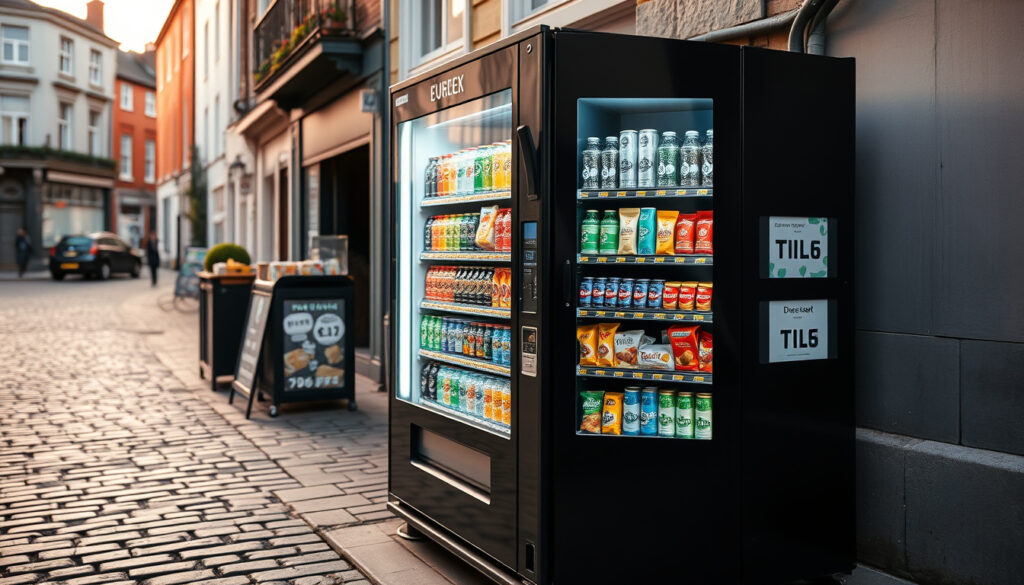
Vending Machine Business Ireland: Costs & Profit
Anyone who’s glanced at a vending machine and wondered “could that be my side hustle?” has probably also hit the same wall: what does it actually take in Ireland? The rules, the costs, the real profit—they’re all a bit foggy when you search online. This guide pulls together the concrete numbers and local regulations so you can see exactly where the opportunity (and the hassle) lies.
Average monthly profit per machine (Ireland): €200-€400 ·
Starting cost range (used): €1,500-€3,000 ·
Machines needed for €100k annual profit: 15-20 ·
License required in Ireland: Yes, Notification of Premises
Quick snapshot
- Food vending operators must register with local environmental health office (Food Safety Authority of Ireland (statutory regulator))
- Used machines in Ireland cost €1,500-€3,000 (Vending-Machines.ie (Irish supplier))
- Well-placed machine nets €200-€400 monthly profit (Vending-Machines.ie (Irish business guide))
- Exact cost of local council fees varies across Ireland (Vending-Machines.ie (licensing guide))
- Monthly profit figures vary by region and machine type (Vending-Machines.ie (supplier data))
- Break-even typically 6-18 months, depending on machine cost and location traffic
- Growth in cashless payment vending; contactless acceptance is becoming standard (Vending-Machines.ie (market trends))
The pattern is clear: margins are real but tight—location and compliance are everything.
| Metric | Value | Source |
|---|---|---|
| Starting cost (used) | €1,500-€3,000 | Vending-Machines.ie |
| Monthly profit average (Ireland) | €200-€400 | Vending-Machines.ie |
| License required | HSE Notification of Premises | Food Safety Authority of Ireland |
| Best location types | Offices, schools, gyms | Vending-Machines.ie |
The implication: you need a strong site and a clean regulatory slate to make the numbers work.
Do you need a licence for a vending machine in Ireland?
If your machine sells food or drink, the answer is yes—you must register as a food business operator. The Food Safety Authority of Ireland (FSAI, the national food-safety regulator) requires you to register with your local environmental health office. This applies to any machine that dispenses items like crisps, chocolate, sandwiches, or drinks.
- Submit a Notification of Premises form to the HSE.
- No separate national vending machine license exists—just the food business registration.
- If your machine is on public property, local council bylaws may require a street trading license (Vending-Machines.ie (licensing guidance)).
Type of license required for food and drink machines
For food vending, the operator is responsible for stock management and hygiene under EU Regulation 852/2004/EC (FSAI guidance). Non-food machines (e.g., toy or gumball) may not need a license depending on the product and location (Vending-Machines.ie).
Location permits and local council rules
Permitting can differ between Dublin, Cork, and other regions (Vending-Machines.ie (regional differences)). Some councils charge a small application fee, others an annual fee. Always check with your local authority before placing a machine.
A single business license may cover your entire fleet, but food machines always need HSE registration—no shortcuts.
The implication: the HSE route is mandatory for food; council fees are the variable you must verify locally.
How much money to start a vending machine?
A used snack or drink machine in Ireland typically costs €1,500-€3,000, while new machines range from €3,000 to €10,000 (Vending-Machines.ie (pricing data)).
- Stocking costs: €200-€500 per machine initially.
- Delivery & installation: €100-€300.
- Payment system setup: cashless readers add €100-€300.
Used machine price range in Ireland
DoneDeal and supplier sites list refurbished machines for as little as €1,500. Budget for a service check before deploying.
New machine cost and financing options
New machines with modern touchscreens and remote monitoring cost €3,000 upwards. Some suppliers offer leasing or finance (Vending-Machines.ie).
Initial stock and setup costs
Stock a machine with a mix of top sellers—chocolate, crisps, drinks—for €200-€500. Rotate based on sales data.
The pattern: a used machine plus stock can get you started for under €2,000, but the add-ons (delivery, payment system) push the real budget closer to €2,500.
Are vending machines profitable in Ireland?
A well-placed machine can net €200-€400 per month profit after stock and electricity (Vending-Machines.ie (profit estimates)).
| Factor | Impact on profit |
|---|---|
| Location foot traffic | Highest determinant – offices, schools, transport hubs |
| Product margin | 50-70% on typical snacks |
| Machine condition | Downtime kills revenue – maintenance matters |
| Cashless payments | Increases sales by 20-30% |
The implication: location is the single lever you control that makes or breaks the return.
Average profit per machine per month
Annual profit per machine: €2,400-€4,800. Break-even: 6-18 months.
Factors affecting profitability
High-traffic sites like offices, schools, and gyms yield best returns. Understocked or outdated machines lose sales fast (Vending-Machines.ie).
Comparison with other passive income methods
Vending machines require active restocking and maintenance—not truly passive. But with proper scaling, returns outperform many small investments.
For an Irish investor, a single machine covers its own cost in under two years if placed in a busy office corridor. The catch: location contracts can vanish.
The pattern: treat vending as active micro-retail, not passive income, and the numbers hold up.
How many vending machines do you need to make 100k?
Assuming €300 monthly profit per machine, you need 15-20 machines to reach €100,000 annual profit (Vending-Machines.ie (scaling estimates)).
Annual profit per machine calculation
€200-€400/month × 12 = €2,400-€4,800/year per machine. At €300 average, 28 machines would yield €100,800—but 15-20 is realistic given downtime.
Scaling strategies to reach €100k profit
Manage multiple locations with a restocking route. Use remote monitoring to reduce trips.
The implication: you cannot get to €100k without a fleet and a route—a single machine is a side earner, not a living.
What is a disadvantage of owning a vending machine?
Vandalism, theft, and machine breakdowns are real risks, especially in unmonitored outdoor spots (Vending-Machines.ie (common pitfalls)). Restocking requires regular trips; machine downtime can lose sales. Host locations may change contracts or close, forcing relocation.
Common pitfalls: theft, vandalism, machine breakdowns
Machines in unsupervised areas are vulnerable. Insurance helps but adds cost.
Ongoing restocking and maintenance costs
Plan weekly or bi-weekly restocking. Maintenance contracts cost €200-€500/year.
Location turnover and contract risks
A host location can cancel anytime. Always have a backup site.
Vending machines offer decent margins but demand hands-on management. Treat it as a business, not passive income.
The pattern: the disadvantages are manageable if you plan for them; the real risk is losing a prime site unexpectedly.
Spec table: Vending machine types in Ireland
The table below maps six machine types—the pattern is clear: food and drink machines face the most regulation but also the highest returns.
| Machine type | Typical cost (used) | License required | Stock cost | Best location |
|---|---|---|---|---|
| Snack machine | €1,500-€3,000 | HSE Notification | €200-€300 | Office break rooms |
| Drink machine | €1,500-€3,000 | HSE Notification | €300-€500 | Schools, gyms |
| Combo (snack + drink) | €2,500-€5,000 | HSE Notification | €400-€600 | Transport hubs |
| Coffee machine | €2,000-€6,000 | HSE Notification + hygiene plan | €150-€300 | Offices, hospitals |
| Non-food (toy/gumball) | €200-€800 | May be none if on private land | €50-€100 | Supermarkets, waiting rooms |
| Milk vending | €3,000-€8,000 | HSE + Dept. of Agriculture (Nesty, Irish business guide) | €200-€400 | Farm shops, local markets |
The implication: if you want the highest returns, you go with food—but you also take on the most regulatory overhead.
Upsides and downsides of vending machines
Upsides
- Low startup cost compared to retail
- Flexible hours – restock on your schedule
- Scalable: add machines as you grow
- Cash flow from day one
Downsides
- Regular restocking required
- Vandalism and theft risk
- Machine breakdowns stop revenue
- Location contracts can end
How do I open a vending machine business?
The following steps take you from idea to first machine in the field.
Step 1: Research and choose a machine type
Start with a used snack or drink machine to minimise upfront cost (Vending-Machines.ie (buying guide)).
Step 2: Secure a location and negotiate terms
Approach local cafés, offices, gyms, or schools for permission. Negotiate a revenue split or flat rental fee.
Step 3: Register with HSE and local council
If selling food/drink, submit a Notification of Premises to your local HSE environmental health office (FSAI). Check council bylaws for any street trading license.
Step 4: Stock and maintain the machine
Stock with best-sellers, monitor sales, clean regularly. Use cashless payments to boost revenue.
The pattern: the steps are linear, but the hardest is Step 2—location access is the bottleneck for profit.
Confirmed facts and what remains unclear
What’s confirmed
- HSE registration required for food/drink vending in Ireland (FSAI).
- No separate national vending machine license exists (Vending-Machines.ie).
- Profit margins depend heavily on foot traffic and product pricing (Vending-Machines.ie).
What’s unclear
- Exact cost of local council fees varies across Ireland (Vending-Machines.ie).
- Monthly profit figures vary by region and machine type (Vending-Machines.ie).
“Food vending machine operators are treated as food business operators and must register with their local environmental health office.”
Food Safety Authority of Ireland (statutory regulator)
“A used snack/drink machine in Ireland typically costs €1,500-€3,000; new machines €3,000-€10,000.”
Vending-Machines.ie (Irish supplier)
“Profits from vending machines are taxable.”
Vending-Machines.ie (Irish business guide)
“Irish milk-vending operators should register their business and comply with Food Safety Authority of Ireland rules.”
The picture is clear: vending machines can be a solid income stream in Ireland, but only if you treat them as a business—not a set-and-forget side hustle. For the Irish operator, the choice is simple: secure a high-traffic location, register correctly, restock regularly, and scale to 15-20 machines, or accept that a single machine is a hobby, not a living.
Related reading: **Vending License Ireland** · **What Type of Business License Do You Need for a Vending Machine?**
linkedin.com, tax.idaho.gov, royalvending.irish, parkinsurance.co.uk, shopify.com, reddit.com, facebook.com
Frequently asked questions
What is the best location for a vending machine in Ireland?
High-traffic areas like office break rooms, school corridors, gym entrances, and transport hubs give the best returns.
Can you run a vending machine business part-time?
Yes, but you’ll need to commit to weekly restocking and maintenance. A few machines can be managed alongside a day job.
Is it better to buy or lease a vending machine?
Buying used minimises startup cost; leasing reduces risk but cuts profit long-term.
Do vending machines need to be insured in Ireland?
Not legally required, but recommended to cover theft, vandalism, and public liability.
What payment systems should a vending machine accept?
Cash and contactless are essential. Many machines now accept cards, phone payments, and even biometrics.
How often do vending machines need restocking?
Typically once a week, but high-traffic machines may need twice weekly.
Are there any tax implications for vending machine income in Ireland?
Yes, profits are taxable. Register with Revenue and declare vending income as self-employed (Vending-Machines.ie).
More related posts
 Suncorp Online Banking – Login, App and Support Guide
 Joe Root: Career Stats, Net Worth, Captaincy & Kohli Comparison
 Blair Athol Medical Clinic: Services, Location, Booking & Billing
 Volodymyr Zelenskyy: Biography, Religion, Presidency, War
 Vanity Bathroom: Guide to Trends and Installation
 Post Office Open Saturday: Hours, Delivery & Services (2025 Guide)
 Stefon Diggs: Net Worth, Relationship Rumors, and Career Stats
 Andy Byron Scandal: Coldplay Kiss Cam, Resignation & Fallout
