Mind Flayer: The D&D & Stranger Things Monster Guide
If you’ve watched Stranger Things and guessed the Mind Flayer was just a scary name borrowed from Dungeons & Dragons, you’re not wrong — but it’s also not that simple. The creature that looms over Hawkins in Season 2 and 3 shares almost nothing with the tentacled, brain-eating illithid of the tabletop game except the concept of psychic domination. This article breaks down what each version actually is, where the show took creative liberties, and why the D&D monster and the Netflix monster are best understood as two different entities with the same label.
First appearance in D&D: 1975 (Eldritch Wizardry supplement) ·
First appearance in Stranger Things: Season 2 (2017) ·
Also known as: Illithid, Shadow Monster ·
Psionic power type: Mind control, telepathy, plane shift ·
Stranger Things creator: Duffer Brothers
Quick snapshot
- Whether the Mind Flayer was truly destroyed in Season 3
- The full origin of the Mind Flayer in Stranger Things
- To what extent the D&D illithid inspired the show’s version
- 1975: Mind Flayer introduced in D&D supplement Eldritch Wizardry
- 2017: Appears as antagonist in Stranger Things Season 2
- 2022: Vecna revealed to be using the Mind Flayer’s form
- Stranger Things Season 5 may resolve the Mind Flayer’s fate
- D&D 2024 rules update will keep illithids as iconic monsters
- Baldur’s Gate 3 continues to popularise the illithid race
Six key facts, one pattern: the Mind Flayer is a different beast in each medium, sharing only the name and psychic control.
| Label | Value |
|---|---|
| First D&D appearance | 1975, Eldritch Wizardry (Wikipedia) |
| Stranger Things debut | Season 2, 2017 (MSN) |
| Alternate name (D&D) | Illithid (Wikipedia) |
| Alternate name (Stranger Things) | Shadow Monster (ScreenRant) |
| Primary power | Psionic mind control (Nerdist) |
| Weakness | Fire (D&D), heat/gate closure (Stranger Things) |
What exactly is the Mind Flayer?
Definition and origins
- In Dungeons & Dragons, a mind flayer – or illithid – is an aberration that feeds on brains and enslaves other creatures through psionic mind control (Wikipedia).
- The creature first appeared in the 1975 supplement Eldritch Wizardry and has since become one of D&D’s most recognisable monsters (Wikipedia).
According to the Dungeons & Dragons official YouTube channel, mind flayers are described as “mentally enslaving other creatures, often leaving victims alive but under control” (Dungeons & Dragons official channel).
The implication: the tabletop version is a biological species with a social structure, not a singular shadow monster.
Mind Flayer in Dungeons & Dragons
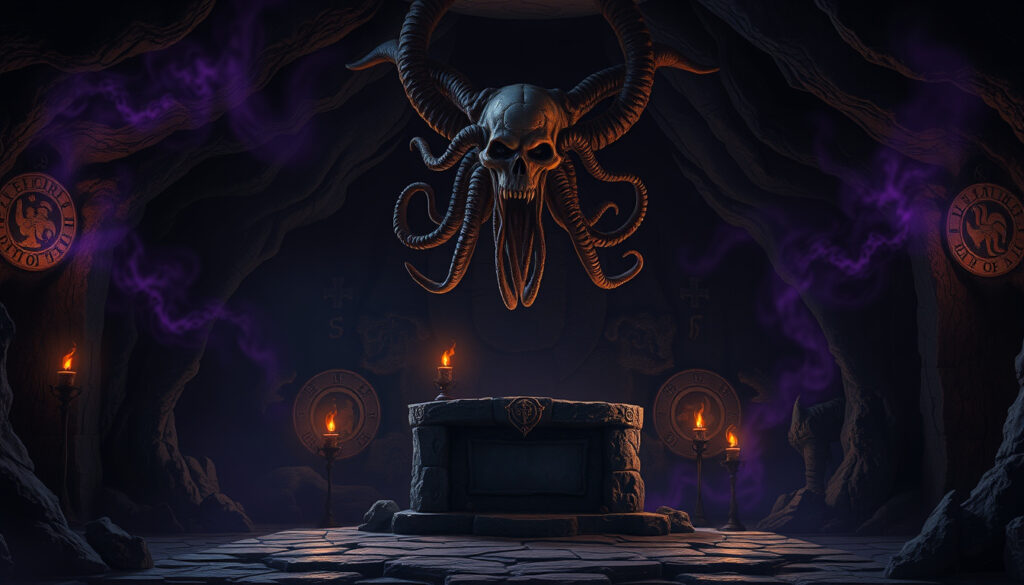
- Illithids are humanoid aberrations with octopus-like heads and tentacles (Nerdist).
- They live in the Underdark and are ruled by an Elder Brain (Nerdist).
The pattern: the tabletop version is a biological species with a social structure, not a singular shadow monster.
Mind Flayer in Stranger Things
- The Stranger Things Mind Flayer is a shadowy entity from the Upside Down that controls a hive mind of possessed humans (ScreenRant).
- It is described as “hundreds of feet tall” in its giant manifestation (The Nerdd).
What this means: the show borrows the name and the concept of mind control, but the creature’s physiology, ecology, and origin are entirely reimagined for television.
Who is the Mind Flayer in Stranger Things?
Role in the series
- The Mind Flayer serves as the overarching antagonist of Seasons 2 and 3 (MSN).
- Dustin explicitly uses the D&D mind flayer as an analogy, saying the creature behaves like a hive mind (Nerdist).
The catch: the name is an analogy, not a description of the same creature.
Connection to the Upside Down
- The entity exists as a psionic hive mind within the Upside Down, controlling the Demogorgons and the flayed humans (ScreenRant).
- It is not a physical creature in the traditional sense but a collective consciousness (MSN).
The pattern: the Mind Flayer acts as an ecosystem, not a single predator.
Relationship with Vecna
- In Season 4, it is revealed that Henry Creel / Vecna has been using the Mind Flayer’s form and connection to the Upside Down to further his own goals (The Nerdd).
- The Mind Flayer existed before Vecna; he shaped it but did not create it (The Nerdd).
The catch: calling the Mind Flayer “Vecna’s pet” oversimplifies the relationship — the entity has its own mysterious origin.
Is the Mind Flayer created by Vecna?
Mind Flayer vs Vecna in Stranger Things
- Vecna (Henry Creel) was the first human to explore the Upside Down and encountered the Mind Flayer there (The Nerdd).
- He didn’t create it — he “shaped” it to his will, bending its power to his own ends (The Nerdd).
The implication: the Mind Flayer predates Vecna and is not his creation.
Origin of the Shadow Monster
- The show has not fully explained where the Mind Flayer came from before Vecna’s arrival (MSN).
- It remains one of the biggest unanswered questions heading into Season 5.
The catch: the Mind Flayer is not a puppet of Vecna in the way many fans assume — it’s more like a natural force that Vecna learned to control.
What is a Mind Flayer in Dungeons & Dragons?
Illithid biology and society
- Illithids are aberrations that feed on brains, using their four facial tentacles to extract them (Nerdist).
- They are psychically connected to an Elder Brain, which directs their actions (Nerdist).
The pattern: D&D illithids are a species, not a singular entity.
Psionic powers
- Mind flayers can dominate the minds of humanoids, telepathically communicate, and even plane shift (Wikipedia).
- In D&D 5th Edition, the standard mind flayer has a Challenge Rating of 7 and can use Mind Blast to stun enemies (Dungeons & Dragons official channel).
What this means: a single D&D illithid is a dangerous but killable foe.
Elder Brain
- The Elder Brain is a giant brain that controls all illithids in a colony (Wikipedia).
- It serves as the hive mind hub — a concept the show repurposed for the Stranger Things Mind Flayer (The Nerdd).
The catch: the D&D mind flayer is a species, not a single villain — that’s a big conceptual difference from the show’s singular entity.
Who killed the Mind Flayer in Stranger Things?
Season 3 climax
- In the Season 3 finale, Eleven closes the gate to the Upside Down, which destroys the “Meat Flayer” — the giant composite form the Mind Flayer had taken (MSN).
- However, the hive mind likely still exists in the Upside Down, as Season 4 confirms the Mind Flayer’s form remains (The Nerdd).
The pattern: the Mind Flayer’s physical manifestation was destroyed, but its consciousness seems to persist — a classic horror trope.
The Stranger Things Mind Flayer isn’t a creature you can stab to death. Its strength lies in being a distributed hive mind. The Duffer Brothers have hinted that Season 5 may finally force a permanent resolution.
Timeline of Mind Flayer appearances
- 1975 – Mind Flayer introduced in D&D supplement Eldritch Wizardry (Wikipedia)
- 1980s – Mind Flayer becomes an iconic D&D monster, appearing in the Monster Manual and numerous adventures
More related posts
 Hayley Atwell: Tom Cruise Rumors, Son Ned, Movies & More
 Morgan Freeman Health Diagnosis, Net Worth & Life
 John Curtin: Wartime Prime Minister, US Alliance, Legacy
 Desmond Bane: Salary, Trade, Height, and Career Stats
 Redmi 6A to Buy: Is It Still Worth Buying in 2024?
 Bob the Builder: Famous Facts, Catchphrase & Voice Actor
 Luigi Mangione: Charges, Health, and Trial Updates
 MS Dhoni: Biography, Career, Net Worth & Personal Life
